Picture this. You are planning a China trip and someone tells you to “go in October for the autumn colors.” Then you read another blog that says October is the worst month because of Golden Week. Then a third one tells you to skip summer entirely. Who do you believe?
This guide breaks down all 12 months — with weather data, crowd patterns, and the two weeks every year to actively avoid. By the end, you will know exactly when to go.
China is 9.6 million square kilometers of weather systems colliding. September and October are when they line up — 22°C in Beijing, 25°C in Shanghai, 18°C in Lhasa, and the kind of clear skies that turn the Great Wall into a postcard. The rest of the year has its own magic, but those eight weeks are why most travel agents quietly tell their friends to book then (China Ministry of Culture and Tourism).
Best Time to Visit China: A Month-by-Month Guide (2025-2026)
Quick answer: September and October for most travelers. May as a backup. February and early October are the two weeks to skip. Everything else depends on what you want to see.
TL;DR
- Sweet spot months: May, September, October (after the 7th), early November
- Two weeks to avoid: October 1-7 (765 million domestic trips in 2024, the highest figure on record) and Chinese New Year week (late Jan or early Feb)
- Best for winter lovers: December through February — Harbin, Beijing, ski resorts
- Best for summer escape: July through August on the high plateau (Yunnan, Tibet, Qinghai)
- Most underrated: November — post-crowd calm, autumn leaves still hanging in the south
- How many days: 7-10 for a first trip; 14 lets you add a nature destination like Zhangjiajie or Guilin
Common Questions
When is the best month to visit China overall?
September and October. Average temperatures sit at 15-25°C across most regions. Rainfall drops 60-70% from summer (China Meteorological Administration). And autumn colors peak from the Great Wall to Jiuzhaigou. May is a close second — 18-28°C and dry, the last comfortable month before humidity rolls in.
What is the worst time to visit China?
Two specific weeks: October 1-7 (National Day Golden Week) and Chinese New Year week (late January or early February). Hotel prices triple. Trains sell out 2-3 weeks ahead. Most Beijing and Shanghai restaurants close for the holiday. In 2024, Golden Week hit 765 million domestic trips — the highest figure on record (China Ministry of Culture and Tourism).
Can you visit China in winter?
Yes. Northern China in winter is a separate category. Harbin Ice and Snow World features 30+ meter ice buildings illuminated at -25°C. Beijing Forbidden City under snow is the shot every photographer wants. The trade-off: pack for -20°C, and expect dry skin for two weeks.
How many days do you need for China?
7-10 days for a first trip — enough for Beijing, Xi’an, and one more stop. 14 days lets you add Zhangjiajie or Guilin for nature. Less than 7 days usually means focusing on one region: Yunnan, the Yangtze, or a deep-dive into one city like Chengdu.
January: Ice Festival and Empty Ancient Capitals
January is when northern China hits its most cinematic mood. Harbin Ice and Snow World opens in early January — ice buildings 30+ meters tall, lit from within, against -25°C air. Beijing and Xi’an drop 50% of their peak-season crowds, so you can stand in the Forbidden City without 200 people in your shot. The Terracotta Warriors feel almost private.
Best Destinations
- Harbin — Ice and Snow World, Central Street (Russian architecture from the railway era), Snow Town a few hours east
- Beijing — Mutianyu Great Wall in snow (less slippery than Badaling), Forbidden City at golden hour, hutong hot pot in Dongcheng
- Xi’an — Terracotta Warriors uncrowded, Muslim Quarter rou jia mo, cycling the Tang dynasty walls (14km loop, 2 hours at relaxed pace)
Weather: -15 to 5°C in the north. Watch out: Harbin can hit -30°C with wind chill. Avoid the last week of January (Chinese New Year falls in late Jan or early Feb — confirm exact dates for your travel year).
February: Lantern Festival and Living Folk Traditions
February is the most misunderstood month. Most guidebooks tell you to skip it — and during Chinese New Year week, they are right. Restaurants close, cities go quiet. But the Lantern Festival (15th day of the lunar new year) is the only time to see folk traditions that disappear the rest of the year. If you are culturally curious, this is your month.
Best Destinations
- Lantern Festival nationwide — Best in Kaifeng (ancient imperial tradition, dragon dance on the city wall), Quanzhou (Minnan lantern heritage, UNESCO-listed), Zigong (the lantern capital since the Tang dynasty)
- Huizhou, Anhui — Hongcun and Xidi villages host fish lantern processions (鱼龙灯) where families have passed the craft down for generations. Bamboo-and-paper lanterns, lit by candles, winding through ponds and moon gates. White walls, red lanterns, black tiles — the visual that defines Jiangnan.
- Chaoshan, Guangdong — Yingge dance (英歌舞, 100+ performers in painted faces), deity parades through narrow alleyways, ancestral worship ceremonies that have not changed in 200 years. The food alone — beef hotpot with cuttlefish balls, oyster omelets, rice noodle rolls — is worth the trip.
- Fujian — Putian 迎神 (deity parade) is the most dramatic in China: communities carry palanquins through the streets, fireworks everywhere, drums going for three days straight. Completely off the foreign tourist trail.
Watch out: Many shops close for 5-7 days around CNY. Plan ahead or fly to a folk-tradition destination where local life continues. Bonus: Yunnan stays 15-25°C in February — Dali and Lijiang work as warm-escape alternatives.
March: Blossoms, Gardens, and Perfect Walking Weather
March is when southern and central China turn into a photographer dream. Rapeseed flowers peak in Wuyuan. Classical gardens bloom in Suzhou. Temperatures hit the 15-20°C sweet spot for walking cities on foot.
Best Destinations
- Wuyuan, Jiangxi — Golden rapeseed fields against white-walled Huizhou villages. Best light is 6-8am, when morning mist has not lifted. Go mid-to-late March.
- Suzhou — Lingering Garden and Humble Administrator Garden in spring bloom. Skip weekends — go Tuesday or Wednesday. Stay near Guanqian Street for evening canal walks.
- Hangzhou — West Lake framed by peach and plum blossoms. Quieter than the autumn chrysanthemum crowd. Rent a bike at Hubin and loop the lake (13km, flat).
- Yangshuo, Guangxi — Li River cycling at its best. Misty karst peaks, green rice paddies, 18-22°C. Stay in a family-run guesthouse in Jiuxian village. Our 3-day Yangshuo adventure covers Li River, Xianggong Mountain sunrise, and village cooking class.
Watch out: Qingming Festival (early April) brings the first domestic travel spike. Book accommodation 2-3 weeks ahead if visiting late March.
April: China Most Beautiful Month
April is the consensus pick among Chinese travel photographers. Spring is full, summer heat has not arrived, and the country iconic landscapes are at peak drama. Crowds are high — book flights and hotels 6-8 weeks ahead.
Best Destinations
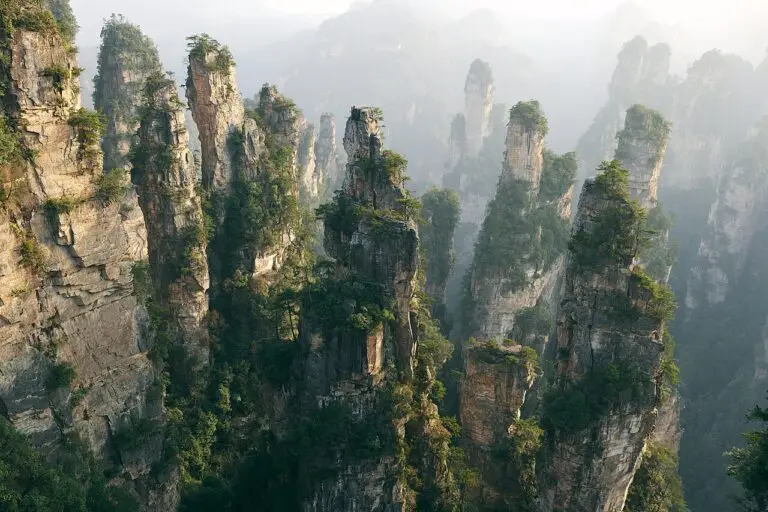
- Zhangjiajie, Hunan — The sandstone pillars that inspired Avatar, with sea of clouds. Best in early morning (6-9am) before clouds lift. Stay inside the park for sunrise access. Our 3-day Zhangjiajie trek covers the main park plus Tianmen Mountain.
- Huangshan, Anhui — Yellow Mountain classic sea of clouds, azaleas in bloom, twisted pines growing out of rock. Stay overnight to catch sunrise from Bright Summit Peak — bring layers, it drops below 5°C at dawn. Try our 2-day Huangshan sunrise trek.
- Guilin, Guangxi — Li River cruise weather is perfect. Karst peaks reflected in calm water. The bamboo raft from Xingping to Nine Horse Fresco Hill is the classic 90-minute stretch.
- Luoyang, Henan — Annual Peony Festival (April-May). China national flower at Longmen Grottoes and ancient temples. The peony gardens at Wangcheng Park are free and spectacular.
Weather: 15-25°C, mostly sunny with occasional rain. Watch out: Zhangjiajie glass bridge queues can hit 2 hours. Book tickets online in advance.
May: Classic Landmarks, Pre-Summer Comfort
May is when China hits its balance point: spring flowers fading, summer heat 6 weeks away, and all the great classics accessible without extreme conditions. Average 18-28°C, low humidity in the north.
Best Destinations
- Beijing — Forbidden City, Temple of Heaven, Summer Palace, Mutianyu Great Wall. All in optimal weather. Skip May 1-3 (Labor Day holiday). The Forbidden City on a Tuesday morning at 8:30am opening is the closest you can get to having it to yourself.
- Xi’an — Terracotta Warriors, ancient city walls (walk or cycle them — 14km loop, bike rentals at South Gate), Muslim Quarter food crawl. The best biang biang noodles are at Yongxingfang, not Beiyuanmen.
- Shanghai — The Bund at night (go at 7pm for the lights), French Concession walking tour, Yu Garden. Best month for walking the city. Skip the Yu Garden bazaar — walk the lanes around Anfu Road for the real Shanghai café scene.
- Chengdu — Panda Base (get there early when pandas are active), Jinli Street, Sichuan hot pot. Try the teahouse culture in Renmin Park — order a gaiwan tea and watch locals play mahjong.
Watch out: Labor Day (May 1-3) brings the year first major domestic rush. Late May is much calmer.
June: Dragon Boats, Lavender Fields, Northern Cool
June marks the start of southern China heat wave — Shanghai and Guangzhou regularly hit 32°C with 80% humidity. Head north or west. June also brings the Dragon Boat Festival (5th day of the 5th lunar month, falls in June), the year most photogenic traditional event — and the only one where the venues are usually free to enter.
Best Destinations
- Diejiao, Guangdong — One of China most spectacular dragon boat traditions. The village S-shaped canal forces crews to navigate sharp bends at full speed. Untouched by mass tourism; you watch from people balconies. Bring cash for the zongzi sellers on the bridge. Our Dragon Boat Festival immersion gets you to the village races plus zongzi-making with local grandmothers.
- Xinjiang — Yili River Valley lavender fields bloom in late June. 16-hour daylight, 20-25°C highland weather. Stay in Huocheng for 2-3 days.
- Ningxia — Zhongwei desert, Yellow River bend at Shapotou, Helan Mountains wine region. Dry, sunny, 22-28°C.
- Dalian, Liaoning — Northern coastal city, 20-25°C summer, beaches at Bangchui Island, fresh seafood at Heishijiao. The escape for northeastern Chinese.
Watch out: Southern China gets humid and stormy in June. Plan indoor activities for midday in Shanghai, Guangzhou, Hong Kong.
July: High Country Escape
July is when lowland China bakes. Shanghai, Chongqing, and Wuhan regularly hit 38°C with 90% humidity. The smart move: altitude. Yunnan, Guizhou, and Qinghai stay 18-25°C all summer.
Best Destinations
- Yunnan (Kunming, Dali, Lijiang) — Kunming averages 22°C year-round. Dali and Lijiang sit 18-25°C. In Dali, skip the main Erhai lake road and cycle the western shore from Xizhou to Shuanglang — fewer tourists, better views.
- Qinghai Lake — Cycling around China largest inland lake. Rapeseed flowers in July, turquoise water, 15-22°C. The 360km loop takes 3-4 days.
- Guizhou — China coolest province. Mountain villages, rice terraces at Jiabang, Dong and Miao ethnic culture. 22-26°C. Stay in a stilted wooden house in a Miao village.
- Inner Mongolia (Hulunbuir) — Vast grasslands, yurt stays with Kazakh families, horseback riding. Dry 20-25°C summer, clear night skies perfect for stargazing.
Watch out: Yunnan and Guizhou fill up fast in July (school holidays). Book accommodation 4-6 weeks ahead.
August: Tibet and the Roof of the World
August is peak season for Tibet and the high plateau. Grasslands are greenest, lakes are fullest, temperatures stay 15-25°C with intense UV. It is also school holiday season — expect crowds at popular destinations, and book Tibet permits 2-3 weeks ahead through a registered travel agency.
Best Destinations
- Tibet (Lhasa, Nyingchi, Namtso) — Potala Palace (book morning tickets to avoid crowds), Barkhor Street for the kora (pilgrimage circuit), holy lakes at their best. The altitude is real — take it slow.
- Gannan, Gansu — Tibetan plateau at lower altitude (3,000m vs Lhasa 3,650m). Labrang Monastery, Sangke grasslands, no altitude sickness for most travelers. A good “training” destination for Tibet.
- Inner Mongolia (Hulunbuir) — Naadam festival (typically late July/early August) with wrestling, archery, horse racing. Grasslands at peak green.
- Shangri-La, Yunnan — Tibetan culture in Yunnan. Pudacuo National Park, Songzanlin Monastery (the “little Potala”), 15-20°C.
Watch out: Lhasa sits at 3,650m. Take the first 2 days slow. Hydrate aggressively. Avoid alcohol the first 48 hours.
September: Autumn Begins, Skies Clear
September is when China starts to deliver. The brutal summer heat breaks, the rains stop, and the skies turn that high-altitude blue. The 7-week window from mid-September to early November is the sweet spot most travelers miss. Hotel rates are reasonable, weather is perfect, autumn colors start appearing in the north by late September.
Best Destinations
- Beijing — Cool, dry, clear. Great Wall at its most photogenic, Forbidden City without the heat. Hotel rates 30% below October peak. Late September is the best time to do the Jiankou-to-Mutianyu wild wall hike — fewer people, perfect temperatures.
- Xi’an — Autumn light on Tang dynasty walls. Terracotta Warriors in comfortable temperatures. Pair with a day trip to Mount Hua (1.5 hours from the city).
- Zhangjiajie, Hunan — Early autumn colors begin. Pillars still green, air clearer than summer, crowds 40% smaller than October.
- Kanas, Xinjiang — Northern Xinjiang in early autumn. Kanas Lake, Hemu Village, golden birch forests.
Watch out: Book popular hotels soon — September is the start of peak season and availability tightens by mid-month.
October: Peak Autumn, Peak Crowds
October is the most popular month to visit China. Autumn colors peak from north to south, weather is dry and clear, and most regions sit at 15-25°C. The catch: the first week is the worst travel week of the year. Travel October 8-31 for the same colors without the chaos.
Best Destinations
- Great Wall (Mutianyu, Jinshanling, Gubeikou) — Peak autumn colors, the Great Wall at its most photographed. Crowds drop sharply after October 7. Jinshanling is the pick for serious hikers — 10km of unrestored wall. Try our sunset hike on the Wall for golden hour photography.
- Jiuzhaigou, Sichuan — Multicolored leaves reflected in turquoise lakes. China most famous autumn destination. Park limits daily visitors to 41,000 — book 1-2 weeks ahead (Jiuzhaigou Valley official site). The “Five-Color Lake” (Wucai Hai) is unreal in person.
- Guilin, Guangxi — Golden rice paddies, clear river water, classic karst in autumn light. The Longji rice terraces turn yellow in mid-October — combine with a 2-day trip.
- Shanghai — 18-25°C, perfect for walking the Bund, French Concession, and Zhujiajiao water town. The plane trees along Fuxing Road start turning gold.
Watch out: October 1-7 is the worst week. Hotels triple in price, trains sell out weeks ahead. Travel October 8-31 for the same colors without the chaos.
November: Quiet Beauty, Autumn Tail
November is China most underrated month. October crowds are gone, autumn colors still hang on in the south, and the weather is mild and dry. It is the most uncrowded month of the cool half of the year, and prices drop back to spring levels.
Best Destinations
- Shanghai — Plane trees lining the former French Concession, café culture, 12-18°C walking weather. The morning fog on the Bund is at its most atmospheric. Our 3-hour Bund walking tour and Zhujiajiao water town day trip work well in November mild weather.
- Chongqing — Hot pot weather begins. Hongyadong night views, the old town steep streets in Ciqikou, the city fiery cuisine. 30-40% fewer tourists than October. Locals do not eat hot pot in the tourist areas — head to the older branches of Qiuyuxuan or Dianshi Qianzi for the authentic ma la experience.
- Hangzhou — Quiet West Lake (locals are back), late autumn foliage at Lingyin Temple, tea house afternoons at Longjing village. Our 2-day Hangzhou tea trail covers the Longjing plantations and West Lake.
- Wuyuan, Jiangxi — Red leaves in ancient villages, misty mornings, the most photogenic autumn scenes outside Beijing. The sun-dried chili peppers on the village rooftops are a November signature.
Watch out: Weather becomes unpredictable. Layer up for early mornings (5-8°C) and strip down for afternoons (15-18°C).
December: Winter Splits, Choose Your Climate
December is when China divides into two distinct travel experiences. The north offers world-class winter wonderlands; the south offers warm beach escapes. The middle is grey and unremarkable — cities like Wuhan, Changsha, or the Yangtze region are not worth the trip in December.
Best Destinations
- Harbin — Ice and Snow World opens mid-December. Buildings made of ice, illuminated at -20°C. The festival peaks in January but December is less crowded and the ice sculptures are already at full size.
- Beijing — Forbidden City in winter light (low sun angle = dramatic shadows), hutong cafés and teahouses at their coziest. Hotel rates at annual low.
- Sanya, Hainan — China Hawaii. 25°C, white sand beaches at Yalong Bay, tropical resorts. Peak winter escape for northern Chinese — book 2-3 months ahead for Christmas and New Year.
- Northern ski resorts — Yabuli (Heilongjiang, the original), Nanshan (Hebei, closer to Beijing), Chongli (near Beijing, hosted the 2022 Winter Olympics). Quality skiing without international resort crowds or prices.
Watch out: Christmas and New Year week fills up Sanya and ski resorts. Book 2-3 months ahead for that window.
How to Use This Guide
Match your travel style to the month. Hate crowds and love autumn colors? Go late September or early November. Want winter magic? January or February. Need summer without the heat? July-August on the high plateau. The only two windows to actively avoid: Chinese New Year week and October 1-7.
For help planning a specific route, get in touch with your travel dates, trip length, and what you want to experience.
Sources
- China Ministry of Culture and Tourism — National Day Golden Week 2024 domestic trip data (765 million trips)
- China Meteorological Administration — regional climate averages used throughout this guide
- Jiuzhaigou Valley official site — daily visitor cap policy (41,000 daily limit)