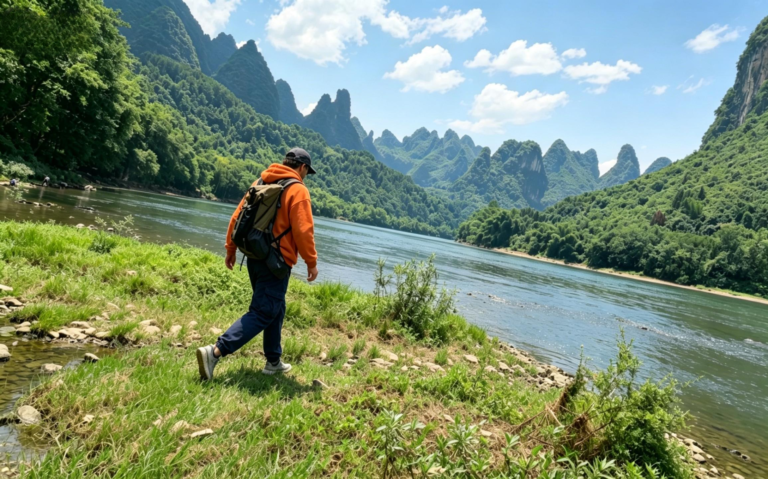
TL;DR
- Zhangjiajie is China’s most surreal landscape — specifically, 3,000 sandstone pillars rising from subtropical forest, the real-life Avatar mountains, and furthermore, a trail that just reopened after 10 years.
- Most visitors see it from above — cable cars, glass walkways, elevators. Also, unfortunately, tour groups rush through in one day. But the Forest Park has five distinct zones. Therefore, hiking gives you a completely different experience.
- Have more time? Tianmen Mountain’s cable car and the Grand Canyon glass bridge are both worth adding to your itinerary. But if your time is limited, we highly recommend spending two full days hiking deep into the Forest Park instead of splitting time across three attractions.
- Direct flights from Shanghai in 2 hours. Furthermore, 240-hour visa-free transit works here. Also, Alipay and WeChat Pay work everywhere. For a complete payment guide, read how to pay in China as a foreigner.
- Stay in Wulingyuan — walking distance to the Forest Park entrance, better restaurants, and therefore, you avoid the daily commute from the city.
Why Zhangjiajie?
Let’s be honest. To put it simply, most Chinese cities look similar — same malls, same chain restaurants, same skyline. But Zhangjiajie doesn’t play that game. Specifically, this place has 3,000 sandstone pillars rising from subtropical forest. Some are over 400 meters tall. According to National Geographic, these quartzite sandstone pillars are among the most dramatic karst formations on Earth. Also, the mist rolls through the valleys like something from a painting. Therefore, thus, it’s no wonder James Cameron used it as inspiration for Avatar.
However, here’s the thing most travel guides won’t tell you. The typical Zhangjiajie trip goes like this: ride a cable car, take photos at a viewing platform, ride a shuttle bus to the next one, repeat. Also, most tour groups finish the entire Forest Park in half a day. Consequently, they see the pillars but never walk through them. Consequently, that’s a missed opportunity. Because, in fact, the real magic of Zhangjiajie isn’t seen from a glass walkway. It’s felt when you’re hiking through primal forest and the pillars emerge from the mist around you.
Furthermore, it’s easier to reach than most people think. Direct flights connect from Shanghai, Beijing, and Guangzhou. According to the Hunan Provincial Department of Culture and Tourism, Zhangjiajie received over 30 million visitors in 2025. Also, the city is compact and walkable. Plus, English signage has improved a lot in recent years. So as a result, even if you don’t speak Chinese, you’ll manage fine.
The Standard Hits
Most Zhangjiajie visitors do three things. Specifically, the Forest Park for the Avatar mountains, Tianmen Mountain for the cable car and glass walkway, and the Grand Canyon for the glass bridge. Moreover, these are all impressive. Therefore, here’s what to expect from each.
Tianmen Mountain (天门山)
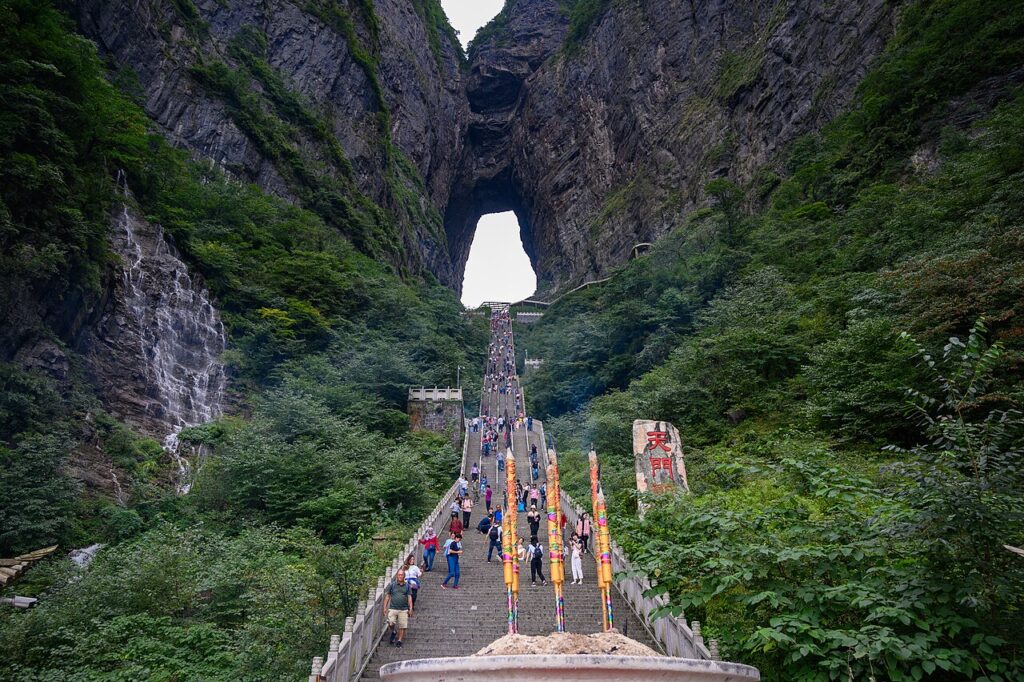
photo by xiquinhosilva@wikimedia
Right next to the city center. First, you take a 7,455-meter cable car ride — one of the world’s longest — straight up the mountain. The ride itself takes about 30 minutes, and specifically, the views of the city below gradually give way to sheer cliffs and forest. Then, at the top, you walk the glass walkway clinging to the cliff face. Also, there’s the famous Tianmen Cave, a natural 30-meter hole in the rock. Furthermore, 999 steps lead up to it. As a result, it’s dramatic and very photogenic. Also, the mountain top has a loop trail that takes about 2 to 3 hours to complete, winding through pine forest and along cliff edges with views of the valley far below.
However, Tianmen Mountain gets extremely crowded. Therefore, go on a weekday if possible. Moreover, buy tickets online in advance. Since they sell out fast during peak season. Furthermore, there are two routes — A-line (cable car up, bus down) and B-line (bus up, cable car down). Also, A-line is more popular. Therefore, B-line usually has shorter queues.
Zhangjiajie Grand Canyon (张家界大峡谷)
The main draw here is the glass-bottom bridge. Specifically, it’s 430 meters long and suspended 300 meters above the canyon floor. Also, it’s the world’s longest and highest glass bridge. Consequently, quite an engineering feat. But the Grand Canyon is more than just the bridge. Specifically, there’s a 3-kilometer hiking trail through the canyon below. Furthermore, you’ll pass waterfalls, streams, and rock formations. Furthermore, the trail includes a glass slide and a small boat ride at the end. Consequently, plan about 2 to 3 hours for the full experience — bridge plus canyon walk.
However, the glass bridge can be intimidating if you’re afraid of heights. Also, during peak season, you may wait in line for 30 minutes just to get on the bridge. Furthermore, the bridge closes during thunderstorms and icy conditions. Therefore, check the weather before you go.
But There’s a Deeper Way to Do Zhangjiajie
Both Tianmen Mountain and the Grand Canyon are worth your time if you have more than two days. But if your time is limited, we highly recommend spending two full days hiking deep into the Forest Park instead of splitting your days across three attractions. Because this is a UNESCO World Heritage Site covering 4,810 hectares with five distinct zones — each one worth half a day on its own.
Moreover, here’s what makes hiking the Forest Park different from the cable-car experience. Tour groups don’t hike. Because it takes too long and it’s too physical for group schedules. As a result, the hiking trails are surprisingly empty. Even in peak season, when Yuanjiajie’s viewing platforms are packed shoulder-to-shoulder, the trail below might have almost nobody on it. Furthermore, the best parts of Zhangjiajie aren’t visible from any platform. Specifically, walking through a valley as 200-meter pillars rise on both sides. Also, following a ridge trail where the pillars drop away beneath you. Plus, hearing nothing but wind and birdsong in a place that gets 30 million visitors a year.
Zhangjiajie National Forest Park — The Five Zones
This is where Zhangjiajie truly becomes unforgettable. Specifically, the park has five main zones, each with its own personality. Furthermore, most visitors only see two of them (Yuanjiajie and Tianzi Mountain — by cable car and elevator). Therefore, here’s what you’re missing if you don’t hike.
Yuanjiajie (袁家界) — The Avatar Icons
This is the postcard. Specifically, the “Hallelujah Mountain” viewpoint — the sandstone pillar that inspired Avatar’s floating mountains. Also, the Mihun Platform where pillars stretch to the horizon. Plus, the First Bridge Under Heaven, a natural rock arch connecting two peaks. Consequently, this zone is unskippable. However, it’s also the most crowded. Therefore, arrive before 8 AM or after 3 PM for the best experience. Furthermore, the Bailong Elevator (a 326-meter glass elevator built into a cliff) brings you up here. Also, it’s the world’s tallest outdoor elevator. Therefore, dramatic entrance guaranteed.
Tianzi Mountain (天子山) — The Panoramic Overlook

photo by JL Cogburn@wikimedia
If Yuanjiajie shows you individual pillars up close, Tianzi Mountain shows you the whole army. Specifically, the viewing platforms here overlook hundreds of sandstone peaks stretching to the horizon. Also, the West Sea Stone Forest — a dense cluster of pillars that looks like a frozen wave. Furthermore, on clear days you can see the entire park. Consequently, this is where you understand the scale of Zhangjiajie.
However, most visitors take the cableway up, snap photos, and leave. But if you’re physically fit, consider hiking up or down Tianzi Mountain instead of taking the cable car both ways. Because almost nobody walks the stairs — it’s a serious workout. As a result, you’ll have the trail almost entirely to yourself. Also, the slow ascent gives you time to take in the scale of the pillars gradually, rather than arriving at the top all at once. Furthermore, this is a pattern throughout Zhangjiajie — the viewing platforms are packed, but the trails are empty. Because tour groups don’t hike. They take the cable car and shuttle bus.
Yangjiajie (杨家界) — The Less-Crowded Entrance
Yangjiajie doesn’t make the top of most itineraries. And that’s exactly why it’s worth visiting. Specifically, Yangjiajie has its own entrance gate to the National Forest Park. Also, while most visitors enter through the main Wulingyuan gate and head straight to Yuanjiajie or Tianzi Mountain, far fewer people come through Yangjiajie. Consequently, it feels quieter from the start. Furthermore, the zone has dramatic ridge trails. Also, the One Step to Heaven path walks along a knife-edge ridge with pillars dropping away on both sides. Plus, the Natural Great Wall — a long ridge of rock formations that genuinely resembles a stone wall winding through the forest. Thus, Yangjiajie is a great choice if you want dramatic scenery without the Yuanjiajie crowds.
Also, most guides will suggest taking the cable car to the viewpoint and skip the hiking trails entirely. Because the trails are tiring and eat into group schedule time. Furthermore, only agencies that specialize in outdoor hiking will actually take you on the ridge trails here. Therefore, as an independent hiker, you get ridge walking almost to yourself. Also, the pillar formations here are different from Yuanjiajie — thinner, more angular, and packed closer together. Like walking through a stone forest on a cliff edge.
Golden Whip Stream (金鞭溪) — The Valley Walk

photo by xiquinhosilva@wikimedia
After all those cliff-top views, you need a breather. Specifically, Golden Whip Stream is a flat, shaded valley walk that runs for 7.5 kilometers along a crystal-clear stream. Moreover, it’s the easiest trail in the park. Furthermore, ancient trees form a canopy overhead. Plus, wild macaques roam the banks. But don’t feed them — they get aggressive.
Consequently, Golden Whip Stream serves two purposes. First, it’s a rest day activity — gentle and cooling. Second, it connects the park entrance to the base of Yuanjiajie. Also, the stream walk itself takes about 2.5 hours. But most tour groups only do the first kilometer — they take a shuttle bus to the stream, walk 15 minutes for a photo, and leave. Therefore, if you walk the full trail, you’ll leave the crowds behind within the first 20 minutes.
Yaozizhai (鹞子寨) — The Trail Tour Groups Won’t Take You On

This is the one that changes everything, without a doubt. Specifically, Yaozizhai closed for safety repairs in 2016 and didn\’t reopen until 2026, as reported by China Daily. Also, during those 10 years, an entire generation of tourists never knew it existed. Therefore, even now, it receives a fraction of the visitors that Yuanjiajie gets. Furthermore, the trail winds through primal forest and along ridge paths with the same dramatic pillar views as the main routes. But without the crowds. Also, without the shuttle bus queues. Plus, without the selfie sticks.
However, Yaozizhai requires actual hiking. Specifically, the easy loop is 8 kilometers. Also, the full loop through Golden Whip Stream is 12 kilometers. Furthermore, the trails are well-maintained but not paved like the main tourist routes. Therefore, this is a trail for hikers — not casual sightseers. Also, no tour group will bring you here. Because it doesn’t fit the “see everything quickly” model that drives group tourism. Consequently, if you want to experience Yaozizhai, you either hike it independently or go with a guide who actually hikes. Either way, you’ll find a side of Zhangjiajie that most visitors never see.
How to Actually Experience the Forest Park
Here’s our honest take. Specifically, the Forest Park needs at least two full days. Moreover, any less and you’re just riding elevators and cable cars between photo stops. Consequently, here’s how we’d do it.
Day 1 — Go Quiet. Start with Yaozizhai. Because the trail is best in the morning when the mist is still in the valleys. Furthermore, the light through the forest canopy is magical before noon. Then, descend through Golden Whip Stream to cool down. Furthermore, this day is about immersion — walking through the landscape instead of looking at it from platforms.
Day 2 — Go Big. Take the Bailong Elevator up to Yuanjiajie for the Avatar views. Then, shuttle to Tianzi Mountain for the panorama. Also, if you have energy, add Yangjiajie for the ridge trail. Therefore, this day is about the iconic sights — the ones you came to Zhangjiajie to see. But because you already spent a full day on the quiet side, you’ll appreciate them more. Because you’ll understand that the pillars aren’t just a backdrop for photos. They’re a world you can walk through.
This is exactly why we designed our Zhangjiajie hiking tour this way. Two days. One quiet secret. All the icons. Because depth beats breadth every time.
Getting to Zhangjiajie
By Air
Zhangjiajie Hehua Airport (DYG) is small but well-connected. Specifically, direct flights from:
- Shanghai — 2 hours, daily
- Beijing — 2.5 hours, daily
- Guangzhou — 1.5 hours, multiple daily
- Shenzhen, Chengdu, Xi’an — also available
Furthermore, the airport is only 30 minutes from the city center. Also, a taxi costs about 60 RMB. Plus, there’s a shuttle bus for 20 RMB.
By High-Speed Train
Zhangjiajie West Station connects to the high-speed rail network. For detailed booking tips and route options, see our China high-speed train guide. Specifically, from Shanghai Hongqiao it takes about 8 hours. Also, from Guangzhou South about 6 hours. Furthermore, overnight trains are available if you want to save on a hotel. But honestly, flying is faster and often cheaper. Therefore, only choose the train if you enjoy rail travel.
Visa-Free Entry
Good news: Zhangjiajie qualifies for China’s 240-hour visa-free transit policy. Specifically, citizens of 54 countries can enter visa-free if arriving from and departing to a third country. Also, you need to enter through an approved port (like Shanghai Pudong) and register with a local hotel within 24 hours. Therefore, check our China visa guide for full details.
Where to Stay
Wulingyuan (武陵源) — Best for Forest Park
This town sits right at the Forest Park entrance. Moreover, it has the most hotel options. Furthermore, plenty of restaurants, convenience stores, and a night market. Therefore, if the Forest Park is your priority, stay here. Because you can walk to the entrance in 10 minutes. Therefore, you’ll save 30 to 40 minutes each day compared to commuting from the city.
Zhangjiajie City Center — Best for Tianmen Mountain
The city center is 30 to 40 minutes from the Forest Park by bus. However, it’s right next to Tianmen Mountain. Moreover, it has more nightlife, bigger restaurants, and better shopping. Therefore, stay here if you’re only doing a one-day hit of Tianmen Mountain plus the Forest Park highlights.
Inside the Park — Mountain-Top Nongjiale
Yes, you can stay inside the Forest Park. Specifically, there are a few options near Yuanjiajie and Tianzi Mountain. Also, some are mountain-top hotels convenient for sunrise views. However, many of the options inside the park are nongjiale (农家乐) — family-run guesthouses converted from farmhouses. Furthermore, these vary wildly in quality. Also, some have basic rooms with hard beds, cold showers, and limited food options. Plus, Wi-Fi is unreliable. Therefore, if you stay inside the park, manage your expectations. Because the convenience of waking up among the pillars comes with trade-offs in comfort.
What to Eat
Hunan cuisine is famous across China for being spicy and flavorful. Also, Zhangjiajie has its own local specialties. Therefore, don’t leave without trying these:
- Tujia three-pot stew (土家三下锅) — the signature dish. Specifically, a hearty stew with pork, tofu, and radish in a spicy broth. Moreover, most restaurants in Wulingyuan serve it. Therefore, it’s the perfect post-hike meal.
- Smoked pork (腊肉) — Tujia-style cured meat. Also, often stir-fried with garlic and chili. Furthermore, rich and savory.
- Wild mountain vegetables (野菜) — foraged greens that grow in the surrounding mountains. Also, usually stir-fried or served in soup. Plus, light and fresh — a nice break from the heavy meat dishes.
- Rice tofu (米豆腐) — not actually tofu. Specifically, it’s a soft rice-flour gelatin served in spicy sauce. Also, a popular street snack.
- Stinky tofu (臭豆腐) — yes, it smells strong. But it tastes amazing. Specifically, deep-fried and served with chili sauce. Also, available at the Wulingyuan night market.
Furthermore, the Wulingyuan night market runs every evening along the main street. Also, it’s a great place to try multiple dishes in small portions. Plus, after a full day of hiking, grazing through a night market beats a formal restaurant every time.
Getting Around
- Park shuttle buses — included with your park ticket. Moreover, they connect all zones inside the Forest Park. However, they get crowded during peak hours. So arrive early.
- City buses — run between the city center and Wulingyuan. Furthermore, the ride takes 30 to 40 minutes.
- Taxis and DiDi — affordable and convenient. Moreover, a ride from the city to Wulingyuan is quick and inexpensive. Plus, drivers generally use the meter.
- Walking — both the city center and Wulingyuan town are compact and walkable. Also, many restaurants and shops are within a 15-minute walk.
Best Time to Visit
For a complete seasonal breakdown, check our best time to visit China guide. Now let\’s focus specifically on Zhangjiajie.
Spring (April to June): Misty and magical. Also, the most photogenic season. Because fog rolls through the pillars creating those floating mountain effects. However, it rains often. Therefore, pack a rain jacket.
Autumn (September to November): Clear skies and comfortable temperatures. Moreover, the best visibility for panoramic views. Furthermore, fewer crowds than summer. Therefore, this is the overall best time to visit.
Summer (July to August): Hot, humid, and packed. Furthermore, Chinese summer holidays mean peak domestic tourism. However, the forest stays cool compared to the cities. So if you must visit in summer, start your days before 7 AM.
Winter (December to February): Quiet and atmospheric. Moreover, snow on the pillars is stunning. But some trails and the glass bridge may close due to ice. Furthermore, the Bailong Elevator sometimes stops running in bad weather. Therefore, check conditions before you go.
FAQ
Is Zhangjiajie worth visiting if I don’t hike?
Yes. Because the cable cars, elevator, and shuttle buses make the main viewpoints accessible without hiking. Also, Golden Whip Stream is a flat valley walk. So you can see the highlights without breaking a sweat. However, the quieter trails — Yaozizhai, the Yangjiajie ridges — require actual walking. Therefore, even a moderate fitness level unlocks a much better experience.
Can I use my phone in Zhangjiajie?
Yes. Because cell coverage is decent throughout the park. Also, Alipay and WeChat Pay work at most vendors. However, some remote trail sections have weak signal. Plus, you’ll need a Chinese eSIM or SIM card for data. Therefore, check our China eSIM guide before you go.
Is Zhangjiajie safe?
Very. Because the trails are well-maintained with railings on steep sections. Also, the park has emergency phones along the main routes. Furthermore, crime is extremely low. However, watch out for macaques — they grab food from hands. Also, the cliff-edge trails in Yangjiajie and Yaozizhai require sure footing. Therefore, wear proper shoes and take your time.
What should I pack?
Sturdy shoes, a rain jacket, snacks, water, and a portable charger. Also, mosquito repellent in summer. Plus, a small backpack to carry everything on the trails. Furthermore, pack layers — because mountain temperatures drop fast in the evening. Therefore, even in summer, bring a light fleece for early mornings.
For more China travel tips, check out our guides on safety in China and visa requirements. Or browse all our China travel guides.