China’s “Water F1”: The Dragon Boat Drift Race That’s Going Viral Worldwide
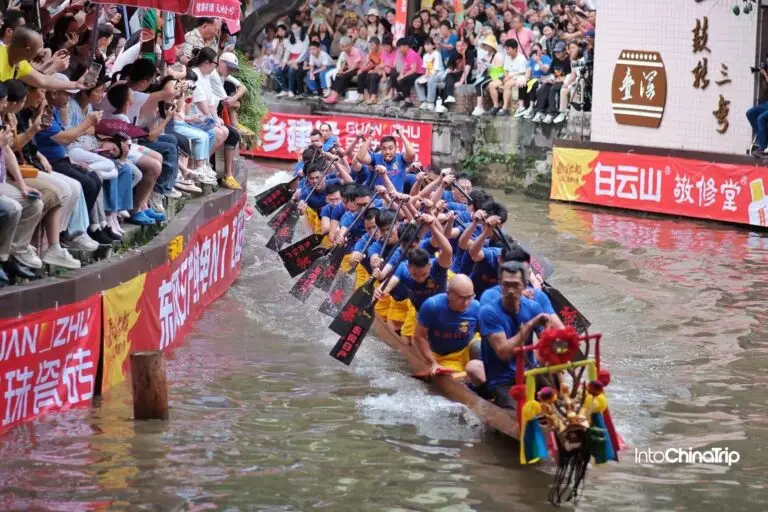
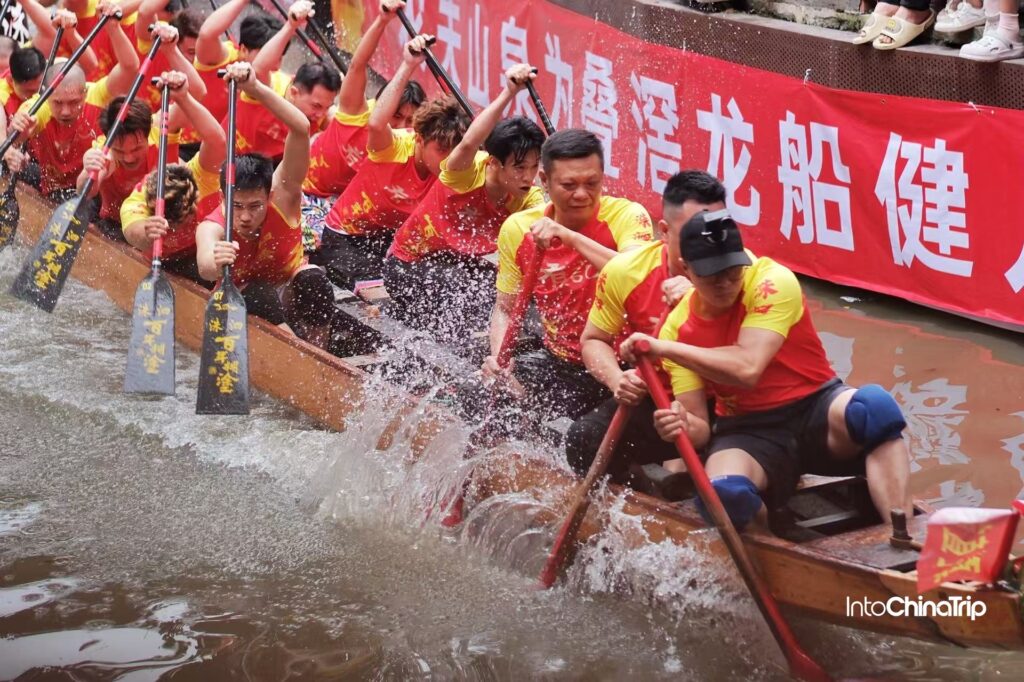
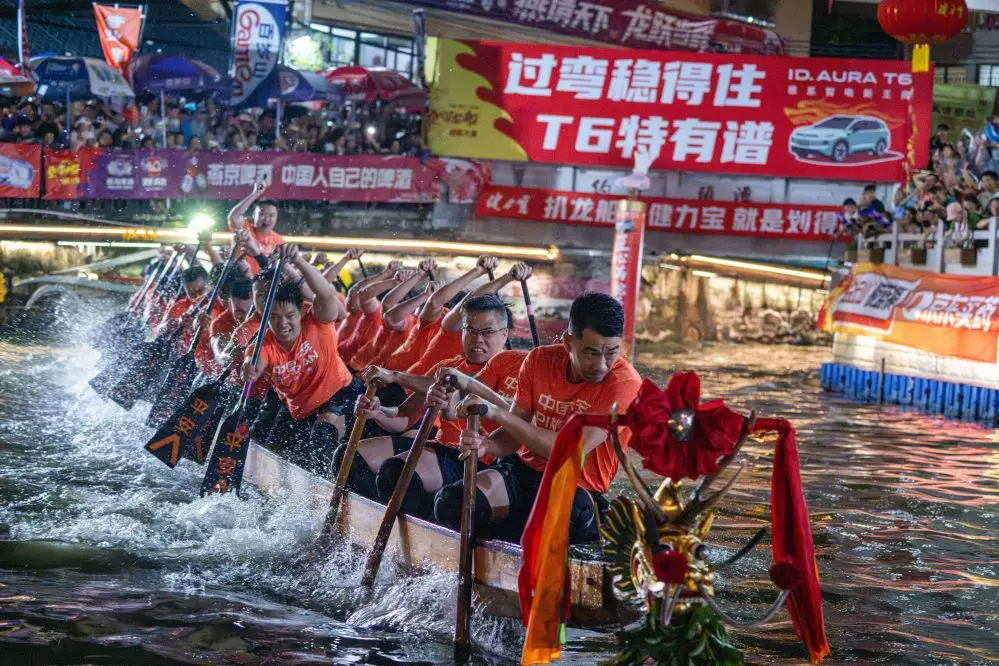
Picture this: a 25-meter wooden boat, packed with 50 rowers, charges full-speed into a river bend so narrow you can almost touch both walls. The helm yanks the rudder, the boat tilts sideways, water explodes against ancient stone embankments, and 10,000 spectators on both banks lose their minds screaming. The boat slides through the corner with inches to spare. Welcome to dragon boat racing Foshan — the most extreme drift race in China.
This is not a movie stunt. In fact, this is dragon boat racing Foshan — specifically the Diejiao dragon boat drift — and it only happens in one place on Earth: a small village in Foshan, Guangdong Province, China. In 2025, our team at IntoChinaTrip brought the first group of international travelers to watch this dragon boat racing Foshan event in person — and it changed how we design every China trip we offer.
If you have seen viral clips of dragon boats drifting through impossibly tight corners, you have already seen Diejiao. Now imagine being there in person, standing so close to the action that water splashes onto your phone screen. Below, you will find everything you need to know about dragon boat racing in Foshan — China’s most extreme dragon boat race — and how you can experience it yourself.
What Makes Dragon Boat Racing in Diejiao Different
The Narrowest Waterways in Dragon Boat Racing
Dragon boat racing is common across southern China. In fact, every city along the Pearl River Delta holds races during the Dragon Boat Festival. However, when it comes to dragon boat racing in Foshan, Diejiao is something else entirely.
The key difference: Diejiao is the only dragon boat race in the world where boats drift through original village waterways under 4 meters wide — there is no other place on Earth where this happens.
The race takes place through the village’s original waterways, which were built centuries ago for local transportation. As a result, these channels are narrow (some bends are under 4 meters wide), winding, and lined with stone walls. In other words, there are no wide open stretches. Every single meter requires precision.
Specifically, the course features four types of bends:
- S-bend: Two consecutive curves in opposite directions. The boat must reverse its drift angle mid-turn.
- C-bend: A sharp, continuous curve. The most technically demanding section.
- L-bend: A near-right-angle turn. The boat must virtually stop and pivot.
- Straight sections: Short bursts of pure speed between bends.
Local racers have a saying: “宁可煲烂,不可扒慢” — “Better to crash into the wall than slow down.” In other words, this philosophy captures everything about Diejiao. Speed and precision are non-negotiable. Moreover, the boats are made from Chinese fir wood — heavy and built for power rather than agility. Therefore, the challenge is to wrestle this heavy vessel through corners at full throttle.
Think of it this way: regular dragon boat racing is like a straight-line sprint. Dragon boat racing in Foshan — especially the Diejiao course — is Formula 1 on water.
A 500-Year-Old Tradition That Just Went Global
From Village Tradition to International Stage
Diejiao has been racing dragon boats through these narrow waterways for over five centuries. In fact, the tradition is woven into the village’s identity. As a result, families prepare for the race all year. Meanwhile, young men train on the water at night after work. During the Dragon Boat Festival, the entire village mobilizes, cooking massive pots of “dragon boat rice” to feed spectators and celebrate victories.
But in 2026, Diejiao crossed a threshold. According to Foshan municipal announcements, the 2026 race hosted an International Elite Challenge for the first time, inviting teams from New Zealand, Australia, and France to compete on the same narrow bends that local teams have mastered over generations.
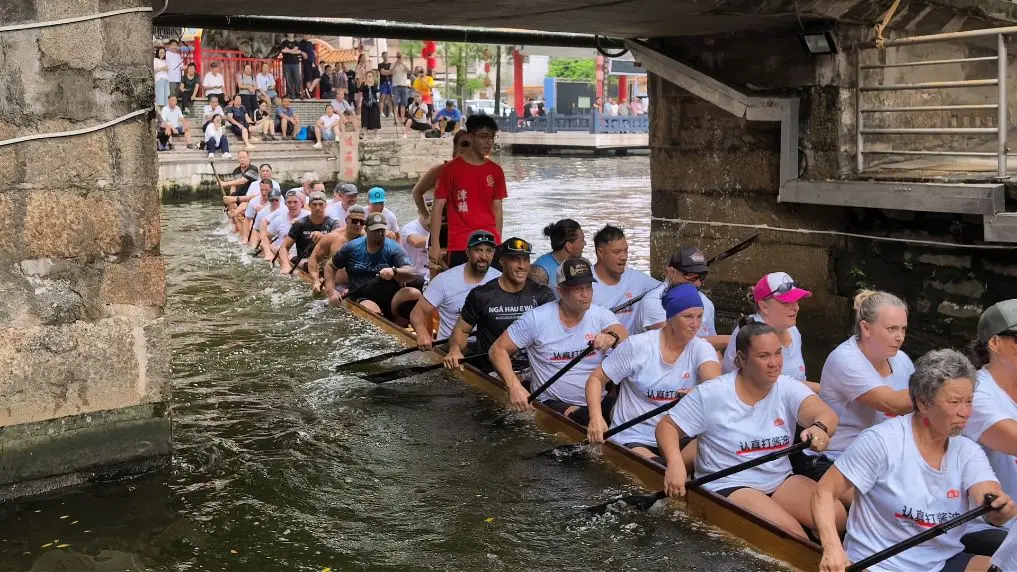
The headline story? A team from New Zealand called Four Seasons Wind. Over 30 members joined the team, and most are of Māori descent. In fact, several are over 60 years old. Furthermore, some are reigning world champions in Waka Ama, a traditional Polynesian outrigger canoe race. They flew across the Pacific specifically to experience Diejiao’s drifting technique.
However, their first practice session was chaotic. Since they were used to racing on wide, open lakes, the New Zealand team kept overshooting the bends and nearly crashing into the stone walls. As a result, local veterans climbed aboard their boat and taught them the art of bend control. Within days, the Kiwis had adapted their Polynesian balance techniques to the narrow waterways.
On race day, the Four Seasons Wind boat, decorated with both Chinese dragon flags and Māori tribal symbols, completed every bend and crossed the finish line to cheers from both local teams and the crowd. Afterwards, the Māori team performed their traditional Haka war dance on the riverbank. In response, the local villagers answered with thundering dragon boat drums. In the end, two boat cultures, separated by 10,000 kilometers, met on the same river.
Why International Visitors Are Drawn to Diejiao
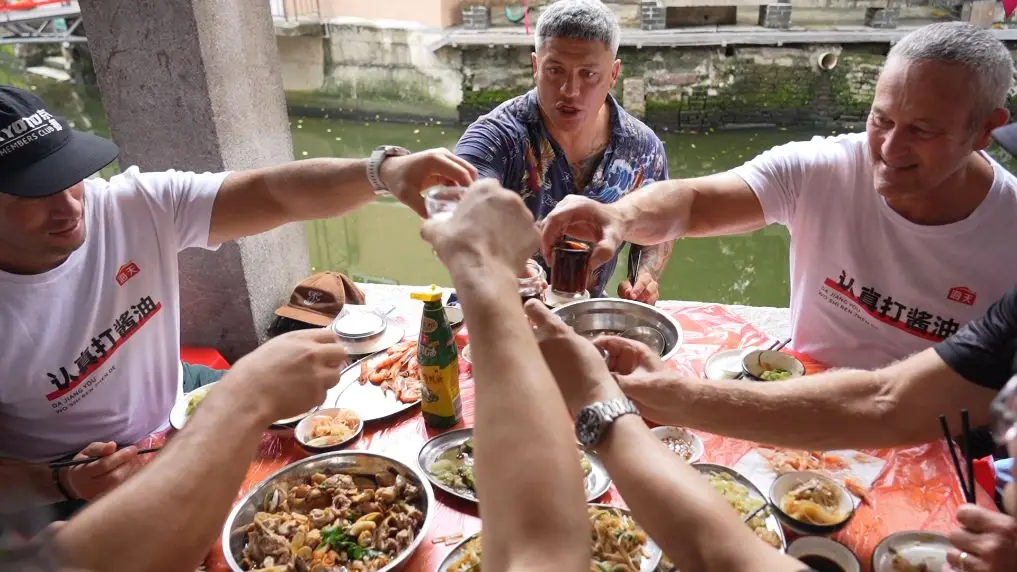
For example, a Dutch blogger named Roland traveled from the Netherlands specifically to experience Diejiao. After seeing the viral videos online, he booked a flight. Then he got on a local dragon boat, felt the C-bend drift firsthand, and described it as: “The curves make everything completely different. When you turn, it is incredibly exciting, and there is this sense of urgency.”
Roland is not alone. According to CGTN, the 2025 Diejiao dragon boat competition attracted over 42 million online viewers. Furthermore, according to local government data, foreign participation in Guangdong’s folk activities grew by 210% year-over-year in 2026. As a result, dragon boat racing in Foshan has become a magnet for inbound tourists who want experiences that go beyond the Great Wall and the Bund.
Here is what draws international visitors:
- Authenticity: This is not a staged tourist show. It is a real village tradition, 500 years old, with real stakes and real local pride.
- Immersiveness: You stand meters from the action. Spectators line both banks, some on balconies overlooking the water. The atmosphere is electric.
- Cultural depth: Beyond the race, there are rituals like dragon boat eye-dotting ceremonies, dragon boat rice feasts, and night training sessions under lanterns.
- Shareability: The visual spectacle is unmatched. A 25-meter boat drifting through a 4-meter gap at full speed makes for content that stops people mid-scroll.
When to Go for Dragon Boat Racing in Foshan
If you want to time your dragon boat racing in Foshan right, here is when to go. The main competition takes place during the Dragon Boat Festival. This falls on the 5th day of the 5th lunar month. In 2027, that date is June 9 (Wednesday). The races run for 2 to 3 days. Different bend courses are held on different days:
Watch Night Training Before the Race
Teams begin intensive training 2-3 months before the Dragon Boat Festival. In fact, in the final month leading up to the race, you can catch night training sessions almost every evening. The sound of drums, splashing water, and shouts under the lantern light is an experience in itself.
| Day | Course | Highlight |
|---|---|---|
| Pre-race (every night, 1 month before DBF) | Night training sessions | Free, up-close view of teams drilling under lanterns |
| Race Day 1 | S-bend | Consecutive reverse curves, the most dramatic drifting |
| Race Day 2 | C-bend | Sharpest arc, highest technical difficulty, spectators closest to the water |
| Race Day 3 | L-bend | Near-right-angle pivot, the loudest course of all |
Beyond the Dragon Boat Festival, the Guangzhou International Dragon Boat Invitational Race usually takes place the following weekend on the Pearl River, featuring teams from 20+ countries. Additionally, starting in 2026, a Dragon Boat Super League runs from July to November with a grand final. As a result, you can catch dragon boat action in Guangdong for much of the second half of the year.
How to Plan Your Dragon Boat Trip to China
Here is the practical side of planning a dragon boat racing trip to Foshan. Diejiao is in Nanhai District, Foshan, about 40 minutes by car from Guangzhou city center. The closest airport is Guangzhou Baiyun International Airport (CAN), which has direct flights from most major cities worldwide.
Quick comparison: Most dragon boat festivals in China happen on wide rivers with open straight courses. However, Diejiao is the only one that takes place through ancient village canals with S-bends, C-bends, and L-bends. As a result, it is the most visually dramatic and technically extreme dragon boat event in the world.
Sample Itinerary
A solid dragon boat trip to Guangdong looks like this:
- First, arrive in Guangzhou: Spend 1-2 days exploring the city. Visit the Shamian Island colonial quarter, the Chen Clan Ancestral Hall, and the Xiguan neighborhood for authentic Cantonese food.
- Next, head to Foshan for the race: Diejiao is a half-hour drive from Guangzhou. Arrive early on race day to secure a good spot along the waterway.
- Then, eat dragon boat rice: Local families and restaurants serve dragon boat rice to visitors for around 50-80 RMB per person. It is a full Cantonese feast with soy sauce chicken, steamed river fish, handmade rice dumplings, and more.
- Finally, try paddling (optional): Some local teams welcome visitors for practice sessions. You will quickly understand why Diejiao racers are considered the best in China.
If you want a hassle-free experience with a guide who handles logistics, translation, and local connections, check out IntoChinaTrip’s Dragon Boat Festival Tour in Guangzhou. We take you to the best viewing spots, arrange dragon boat rice with a local family, and connect you with the racing community.
Practical Tips for Visiting Diejiao
Here are a few things that will make your trip smoother:
- Language: Very few locals speak English. A translation app on your phone is essential. If you are not comfortable navigating without English, a guided tour removes all the friction.
- Transport: There is no direct metro to Diejiao. The easiest option is a taxi or hired car from Guangzhou (about 40 minutes). During race days, roads near the village get congested. Arrive early or plan to walk the last 15 minutes.
- Crowds: Race days draw tens of thousands of spectators. If you prefer a more relaxed experience, come a month early — in the final month before the Dragon Boat Festival, teams train almost every night, and you can watch up close from the riverbank. The atmosphere is intense but the crowds are smaller and more local.
- Weather: June in Guangdong is hot and humid (30°C+, frequent rain). Bring sunscreen, a rain jacket, and water. The race happens rain or shine, and locals will tell you that rain actually makes the drifting more dramatic.
- Photography: You can shoot freely from the spectator areas. Bring a wide-angle lens for the bends and a zoom for the boat expressions. A waterproof phone case is smart — you will be close enough to get splashed.
- Respect: This is a real village, not a tourist attraction. Respect local customs, ask before photographing people up close, and do not block the waterways or race areas.
Beyond Dragon Boats: What Else to Do in Foshan
Foshan is one of those Chinese cities that international tourists rarely visit, which is a genuine shame. Here are three reasons why you should add a day:
- Martial arts heritage: Foshan is the hometown of Ip Man (Wing Chun), Wong Fei-hung, and Bruce Lee’s ancestral roots. Visit the Ip Man Hall and Wong Fei-hung Memorial Hall.
- Ceramics capital: Foshan has been China’s ceramics center for centuries. The Shiwan ceramic district has working studios where you can watch artisans at their wheels.
- Shunde food district: UNESCO recognized Shunde (a district of Foshan) as a City of Gastronomy. The food here rivals — and many locals argue surpasses — Guangzhou’s famous Cantonese cuisine.
Final Thought
Most travelers to China follow the same path: Beijing, Xi’an, Shanghai, maybe Guilin. While these are all incredible, they represent the “greatest hits” version of China. In contrast, the real magic happens when you go deeper — into villages where 500-year-old traditions are still alive, where a Dutch blogger and a Māori champion can sit down for dragon boat rice with a Foshan farmer and bond over the universal language of boats and water.
Diejiao is that kind of place. It is raw, authentic, and completely unlike anything you have experienced before. The dragon boats are waiting. At IntoChinaTrip, we have been organizing dragon boat racing in Foshan for international visitors since 2025, and we would be glad to help you plan the trip, too.
Frequently Asked Questions
Q: When is the Dragon Boat Festival in 2027?
A: The Dragon Boat Festival falls on June 9, 2027 (Wednesday). The Diejiao dragon boat racing in Foshan typically takes place on the festival day and the surrounding 1-2 days, running for 2-3 days total. We recommend arriving in Foshan at least one day early.
Q: How do I get to Diejiao from Guangzhou?
A: The dragon boat racing venue in Diejiao is in Nanhai District, Foshan, about 40 minutes by car from central Guangzhou. There is no direct metro station. The easiest option is a taxi or hired car. On race days, roads near the village get congested, so arrive early or plan to walk the last 15 minutes.
Q: Can I watch dragon boat training before the race?
A: Yes. Teams begin intensive training 2-3 months before the Dragon Boat Festival. In fact, in the final month leading up to the race, night training sessions happen almost every evening. You can watch for free from the riverbank — the sound of drums and splashing water under the lanterns is an experience in itself, with far fewer crowds than race day.
Q: Is Diejiao suitable for first-time visitors to China?
A: Yes, with some preparation. First, very few locals speak English, so download a translation app or join a guided tour with English-speaking guides (such as IntoChinaTrip’s dragon boat tour). Second, watching the race is free — no tickets required. Third, June in Guangdong is hot and humid, so bring sunscreen and a rain jacket. Overall, it is an experience you will never forget.
By the IntoChinaTrip Team — we have been organizing dragon boat racing experiences in Foshan since 2025. Our guides are local to Guangdong, and we specialize in helping international visitors access authentic cultural events that are hard to reach on their own. If you have questions about planning a trip around the dragon boat racing in Foshan, get in touch with us.