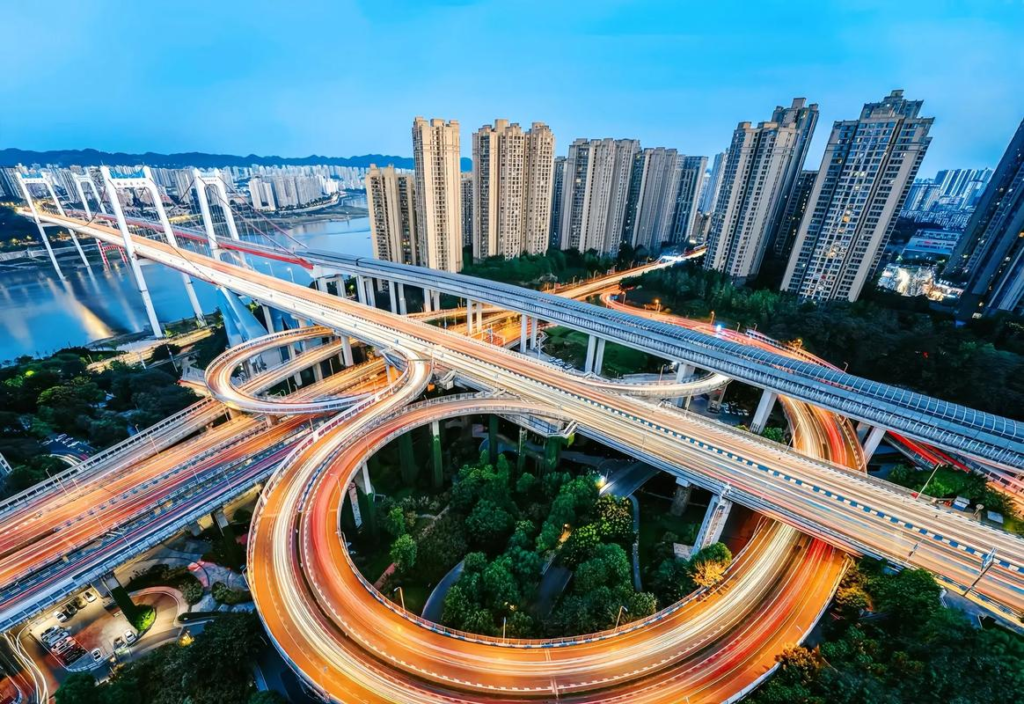
Chongqing is not like any other city in China. It is a place where subway trains run through apartment buildings, where the 1st floor of one building is the 10th floor of another, and where entire neighborhoods hang off cliffs above the Yangtze River. With 31.87 million residents across its municipal area, Chongqing is one of the largest cities on earth. But what makes it famous is its insane vertical geography, which earned it the nickname “the 8D cyberpunk city.”
This guide is built around a 3-day itinerary, but most first-time international travelers only give Chongqing 2 to 3 days — many split that time with nearby Chengdu. This 3-day version is the relatively complete Chongqing experience: one full day in the city, one day for nature, one day for culture. The pace is comfortable, not rushed. If you only have 2 days, you can easily drop Day 3 (Dazu Rock Carvings) and focus on the city highlights plus the Wulong Karst day trip.
By the end of this guide, you will know exactly what to do each day, where to stay, and which guided tours make the logistics effortless. Let us dive in.
Why Visit Chongqing
You might be wondering: is Chongqing worth my time in China? The short answer is yes — and here is why.
First, Chongqing offers something no other Chinese city can: a truly three-dimensional urban experience. Shanghai has the Bund and Beijing has the Forbidden City, but neither can match Chongqing’s “you have to see it to believe it” cityscape. The monorail slicing through a 19-story building at Liziba? That is real. The hanging walkways of Mountain City Alley? Those are real too.
Second, Chongqing is the gateway to two UNESCO sites you cannot easily reach from anywhere else. The Wulong Karst, with the world’s tallest natural bridge, is a 2.5-hour drive away. The Dazu Rock Carvings, with more than 50,000 Buddhist statues carved into cliffs, is about the same distance. Both are best done as day trips from Chongqing.
Third, the food alone is worth the trip. Chongqing is the birthplace of Sichuan hotpot — that bubbling, fiery, numbing-spicy cauldron where you cook your own meat and vegetables. Every neighborhood has its own hotpot shops, and eating hotpot is as much a social experience as a culinary one. Beyond hotpot, you will find Chongqing noodles, spicy crayfish, and countless street snacks.
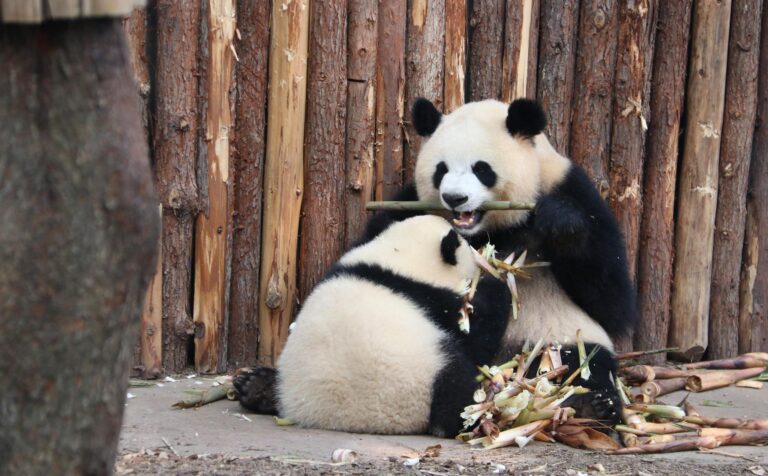
Fourth, Chongqing pairs perfectly with other destinations. If you have more time, you can easily extend with a trip to Chengdu (the panda capital, 1.5 hours by high-speed train) or Zhangjiajie (the Avatar mountains, just over 2 hours by high-speed train). The city is a natural stop on any southwest China itinerary.
Pro tip: Avoid visiting during China’s “golden weeks” — Labor Day (May 1-5), National Day (October 1-7), and Spring Festival (January or February). Every popular spot gets packed, hotel prices double or triple, and you will spend half your time waiting in lines.
Day 1 — The 8D Cyberpunk City
Your first day is all about experiencing Chongqing’s most famous quirk: its vertical cityscape. The route follows a natural west-to-east flow across the Yuzhong peninsula, covering eight iconic stops — from a hilltop park at sunrise to the glowing skyline at night.
This itinerary is exactly the route of our Chongqing 8D: Cyberpunk City Walk tour. Joining the tour with a local guide who knows all the hidden alleys and best photo spots is the easiest way — they handle navigation, explain history, and get you to viewpoints before the crowds.
Eling Park — Two Rivers Pavilion
Start your day at Eling Park, the highest point on the Yuzhong peninsula. Climb the Two Rivers Pavilion and you get a sweeping 360-degree view of both the Jialing River and the Yangtze River winding through the city. This quiet hilltop park has been a Chongqing landmark since the 1930s — the perfect place to wrap your head around just how dramatic this city’s geography is.
Three-Layer Road & Liziba Monorail
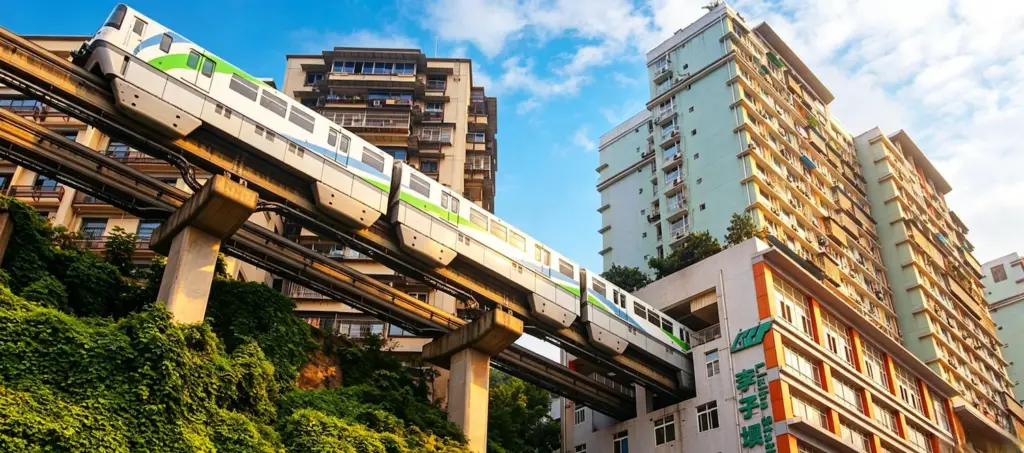
From Eling Park, wander down to Three-Layer Road, a quirky hillside street stacked with cafes, art shops, and old residential buildings — a taste of local life before the main event. At the bottom is Liziba Station, the spot that made Chongqing internet-famous: a monorail train that drives straight through a 19-story residential building. Fun fact: the building and the monorail were designed and built at the same time.
Jiefangbei & Bayi Food Street
Next up is Jiefangbei — Chongqing’s most iconic commercial district, where the WWII victory monument stands surrounded by glowing skyscrapers and luxury malls. Just steps away is Bayi Food Street, the most famous snack street in town. This is where you lunch on Chongqing spicy noodles, stinky tofu, skewered meat, and all the street food classics.
Mountain City Alley (Shancheng Xiang)
From Jiefangbei, head south to Mountain City Alley. This is where Chongqing’s “cliff city” vibe hits hardest. It is a pedestrian path built into the side of a steep cliff, high above the Yangtze River, with wooden walkways hanging over the edge and traditional courtyard houses perched on stone foundations. Stop for a cup of gaiwan tea at one of the cliffside tea houses.
Eighteen Stairs (Shibati)
Walk to the Eighteen Stairs, a restored historical neighborhood that connects the upper city with the lower city via 18 zig-zagging stone stair flights. Though recently rebuilt, it still captures the feeling of walking down a stairway that has linked two halves of the city for centuries.
Chaotianmen — Two Rivers Confluence
At the very tip of the Yuzhong peninsula is Chaotianmen, where the green Jialing River meets the brown Yangtze River. The two different-colored waters do not mix for quite a distance — a striking natural phenomenon you have to see to believe.
Hongyadong & Qiansimen Bridge
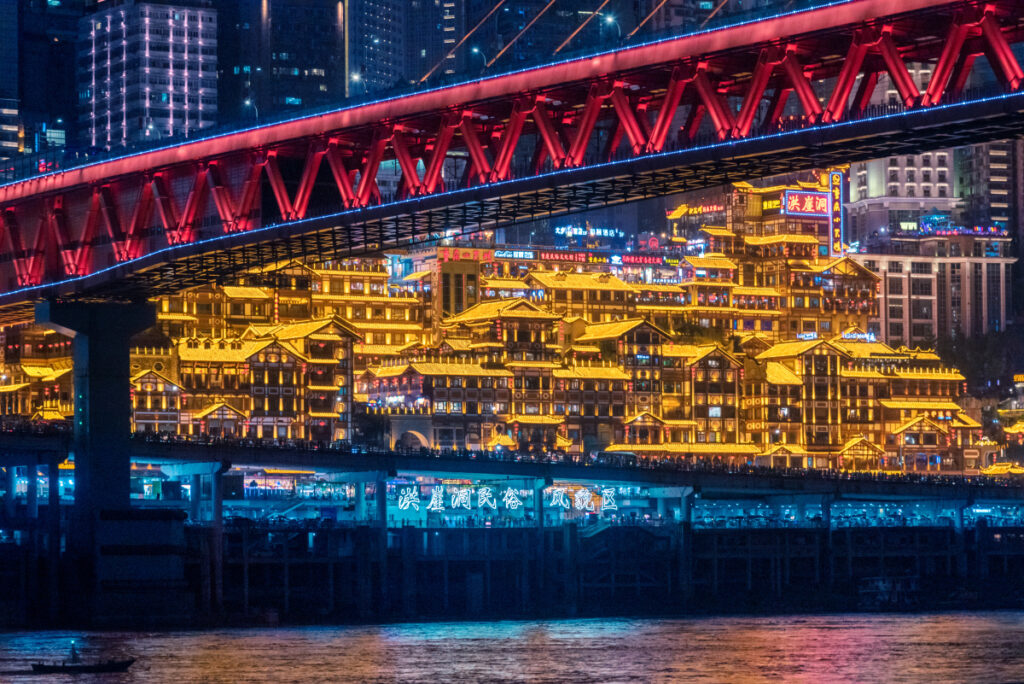
Your day ends at Hongyadong — the poster child of Chongqing’s cyberpunk aesthetic. This 11-story stilt-house complex built into the side of a cliff comes alive at night with thousands of golden and red lanterns. It looks like something straight out of a Studio Ghibli movie. For the best view, walk across the Qiansimen Bridge. The sight of Hongyadong glowing on the cliffside with the river below is the iconic Chongqing photo, and the perfect grand finale to your first day.
Day 2 — Wulong Karst: UNESCO Natural Heritage
Your second day takes you out of the city and into one of China’s most spectacular natural landscapes. The Wulong Karst is part of the South China Karst UNESCO World Heritage Site, recognized for its towering natural bridges and giant collapse depressions called tiankeng (sky holes).
Wulong is about 180 kilometers east of downtown Chongqing. Getting there by public transport is possible, but the main sites are spread out and logistics get complicated once you arrive. For most first-time visitors, a guided day trip is the way to go.
Our Wulong Karst Day Trip includes round-trip transport from your hotel, all entrance tickets, the 80-meter cliff elevator, and an English-speaking guide. You will visit both major sites — Three Natural Bridges and Longshuixia Gorge — and be back in Chongqing by dinner time.
Three Natural Bridges
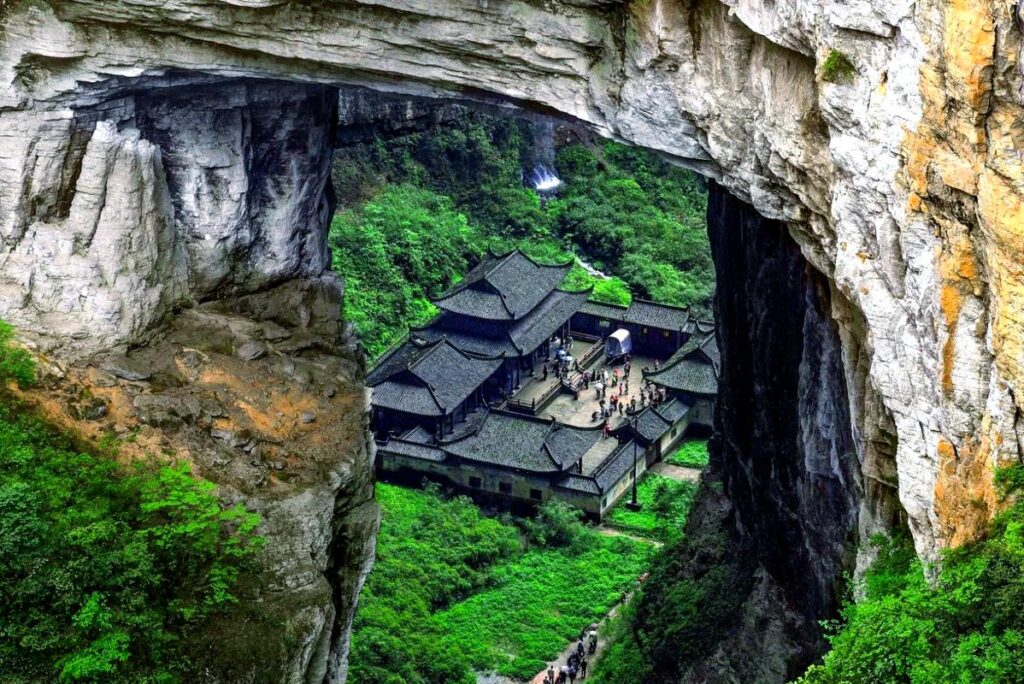
The Three Natural Bridges — Tianlong, Qinglong, and Heilong — are the star attraction of Wulong. Three massive limestone arches span a deep gorge that was once an underground river, carved by millions of years of water and time. The most impressive is Qinglong Bridge, standing 281 meters tall — taller than the Golden Gate Bridge’s towers.
You take an 80-meter glass elevator down to the valley floor, then walk through all three bridges. Nestled between Tianlong and Qinglong Bridge is the Tianfu Official Post. It is a reconstructed ancient post station that has been a filming location for major movies like Transformers: Age of Extinction and Zhang Yimou’s Curse of the Golden Flower.
Longshuixia Gorge
After the Three Natural Bridges, the second part of the day is Longshuixia Gorge — a narrow, deep geological fracture with walls 200-500 meters high, and in some places the gap at the top is only a few meters wide.
The walk follows a wooden boardwalk built into the cliffside, passing under waterfalls that cascade directly onto the path. More intimate and mysterious than the grand scale of the Three Natural Bridges, Longshuixia feels like stepping into another world entirely.
Day 3 — Dazu Rock Carvings + Ciqikou
On your third day, trade natural wonders for cultural treasures. The Dazu Rock Carvings are a UNESCO World Cultural Heritage Site with more than 50,000 Buddhist, Taoist, and Confucian statues carved into cliff faces between the 9th and 13th centuries. UNESCO describes them as “exceptional evidence of the harmonious synthesis of Buddhism, Taoism, and Confucianism.”
Dazu is about 120 kilometers west of Chongqing. There are five major sites, but the two most important are Baodingshan and Beishan. Getting there on your own is doable, but you will miss the context — these carvings are full of stories and symbolism not obvious to the untrained eye. Our Dazu Rock Carvings Day Tour includes round-trip transport, all tickets, and an expert guide who brings the stories behind each carving to life.
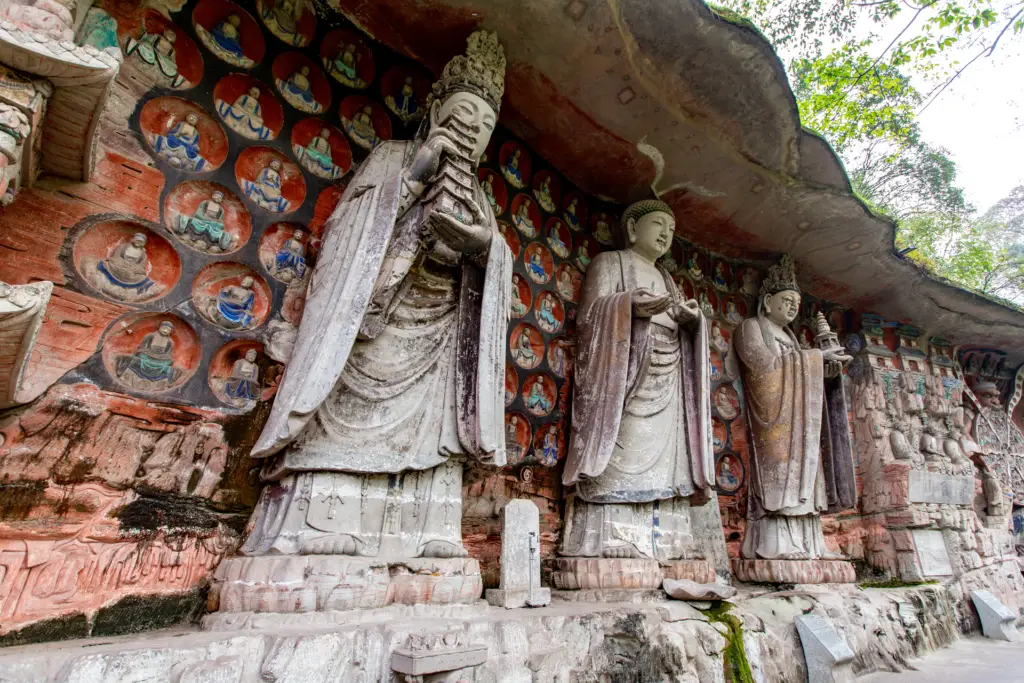
Baodingshan
Baodingshan is the main event. Carved in the 12th and 13th centuries under the direction of a monk named Zhao Zhifeng, this site is essentially an outdoor Buddhist textbook. Every carving tells a story about karma, rebirth, compassion, and the Buddhist path to enlightenment.
The most famous piece is the Reclining Buddha, a 31-meter-long carving of Buddha entering nirvana. It is the largest reclining Buddha in the world carved into a cliff face. Another highlight is the 1000-Hand Guanyin, a breathtaking golden-leaf-covered statue with 1,007 arms, each holding a different sacred object.
Beishan Caves
After Baodingshan, head to Beishan (North Mountain). Beishan has more than 10,000 statues carved between the late Tang Dynasty and the Southern Song Dynasty. The style here is different from Baodingshan — more refined, more delicate, and focused on individual Bodhisattva figures rather than narrative scenes.
Beishan is often called the “Guanyin Gallery of China” for its many depictions of Guanyin, the Bodhisattva of compassion. The most famous is the “Whispering Guanyin” — a figure with a gentle, almost smiling expression that feels remarkably alive.
Evening: Ciqikou Ancient Town
You will be back in Chongqing by late afternoon. If you still have energy, head to Ciqikou Ancient Town for the evening. This 1,000-year-old town sits on the banks of the Jialing River and was once a busy port on the old tea and salt trade routes.
Today, Ciqikou is a mix of tourist shops, tea houses, and snack streets. It gets crowded, but it is still charming — stone lanes, wooden buildings, red lanterns, and the sound of Sichuan opera drifting from the tea houses. It is also the perfect place to pick up souvenirs.
Where to Stay in Chongqing
Where you stay in Chongqing makes a big difference, because getting around the hilly city takes time. Here are the two best areas for first-time visitors.
Jiefangbei / Hongyadong area — This is the most convenient choice for tourists. You are within walking distance of Jiefangbei, Hongyadong, Bayi Food Street, and the Two Rivers Confluence. The night views are spectacular, and you will save a lot of time on transportation. The downside? It can be noisy and hotel prices are higher. Still, for a short 2-3 day trip, this is where we recommend staying.
Guanyinqiao area — If you want more of a local living feel, Guanyinqiao is a great alternative. It is one of Chongqing’s busiest commercial districts but less touristy than Jiefangbei. You will find great local restaurants, shopping malls, and a vibrant nightlife scene. It is well connected by metro, and hotel prices tend to be more reasonable.
More Places to Explore in Chongqing
Three days gives you the essentials, but Chongqing has a lot more to offer if you have extra time. Here are a few more spots worth considering.
Nanshan Tree Viewing Platform — The best panoramic view of Chongqing’s skyline is from Nanshan (South Mountain). The “One Tree” platform looks out over the entire Yuzhong peninsula and both rivers. Especially stunning at night when the whole city lights up.
Yangtze River Cableway — For decades, this cable car was regular transportation across the Yangtze for locals. Today it is a tourist attraction, but still offers a unique perspective. You glide high above the river with bird’s-eye views of the skyline and busy shipping below. The actual ride is only 4-5 minutes, but during peak season or weekends, you could wait in line for hours. Book 1-2 days in advance via the official WeChat mini-program or an OTA platform to skip the queues.
Sichuan Fine Arts Institute Graffiti Street — Near Chongqing Medical University, this entire street is covered in graffiti and street art by students from the nearby Sichuan Fine Arts Institute. Walls, buildings, and even the road are painted. It is a colorful, artsy neighborhood with cafes and independent shops — a nice contrast to Chongqing’s historical and natural sights.
Tianyan Cave Rappelling
If you want something truly different — the kind of experience your friends back home have never heard of — Tianyan Cave Rappelling is it. This is one of those rare activities in China that combines adventure, photography, and natural wonder in a single package.
Tianyan Cave sits in Beibei District, about 80 minutes from downtown Chongqing. The cave has a dramatic natural skylight opening at the top. When sunlight streams through, it creates visible beams of light that illuminate a 32.8-meter stone Buddha carved into the cave wall. The effect is otherworldly — like stepping into a scene from a fantasy film.

The main activity is rappelling 60 meters down through the skylight into the underground chamber. A professional photographer captures every moment, so you get both the adrenaline rush and the photos to prove it. The cave stays at a constant 18–22°C year-round, making it a perfect escape from Chongqing’s brutal summer heat.
This tour has become one of our most talked-about Chongqing experiences. Visitors consistently say it is the highlight of their trip — the kind of thing you cannot find anywhere else. If you have an extra half-day and want a story worth telling, book it.
Getting Around Chongqing
Getting around Chongqing is easier than you might think — as long as you are ready for hills, stairs, and escalators that go between entire neighborhoods.
The metro system is your best friend. Chongqing has 12 metro lines covering all the major tourist spots. Line 2 is the famous “monorail through the building” line, and Line 1 takes you to Ciqikou and the area around Eighteen Stairs. A single ride costs 2-7 RMB depending on distance.
For payment, you can use the official Chongqing Metro app or tap with a bank card. For more details on how to pay for transport and everything else in China, read our complete guide to paying in China.
Didi (China’s ride-hailing app) is also widely available. It is cheap — most rides within the city center cost 15-30 RMB — and it saves you from figuring out which floor of which building you need to be on. Just set your pickup point at the main entrance of wherever you are.
Practical Tips for First-Time Visitors
Visa & Entry
Chongqing is one of the cities covered by China’s 240-hour visa-free transit policy. If you are passing through on your way to or from another country, you can stay for up to 10 days without a visa. If you need a full tourist visa, the process is straightforward but does require some paperwork. For all the details, check our complete China visa guide.
Language & Navigation
English is not widely spoken in Chongqing, especially outside of major hotels and tourist spots. Download a translation app before you go. We recommend Doubao AI — it works offline for basic text translation and handles Chinese speech recognition well. Point your camera at a menu or street sign and it will translate it in real time.
A word of warning: Chongqing’s roads are so complex that navigation apps rarely give you the correct route. Locals have a saying: “Don’t look at your navigation — just ask someone.” But the language barrier makes already confusing directions even harder to follow. This is where a local guide who knows the city inside out saves you hours of getting lost and frustrated — they know all the vertical shortcuts and can navigate this 8D city with ease.
Money & Payments
China is basically a cashless society these days. Most places take Alipay and WeChat Pay. You can link a foreign credit card to both apps now, but the setup can be tricky. For everything you need to know — from setting up mobile payment to using ATMs — read our China payment guide.
What to Pack
- Comfortable walking shoes — you will climb a lot of stairs and walk up and down hills all day.
- A small umbrella or foldable rain jacket — Chongqing is humid and it rains often, especially in spring and summer.
- Power bank — you will use your phone a lot for navigation, translation, and payments.
- A reusable water bottle — tap water is not drinkable, but you can refill at hotels and some restaurants.
Plan Your Trip
This 3-day itinerary gives you the best of Chongqing — the cyberpunk cityscape, the UNESCO natural heritage, and the UNESCO cultural heritage. You will see why Chongqing has become one of China’s most talked-about travel destinations.
If you want to make the most of your time without the stress of planning, we recommend joining our three signature tours:
- Chongqing 8D: Cyberpunk City Walk — Your Day 1 itinerary, guided by a local who knows every hidden alley and photo spot.
- Wulong Karst Day Trip — Three Natural Bridges and Longshuixia Gorge, with round-trip transport and an expert guide.
- Dazu Rock Carvings Day Tour — Baodingshan and Beishan, with context that brings 1,000 years of art to life.
For more inspiration on what to see, where to eat, and where to stay in Chongqing, head over to our complete Chongqing destination guide. We update it regularly with new tours, hidden gems, and neighborhood recommendations.
And if you have extra days, consider extending your trip. Chengdu — the capital of Sichuan, famous for pandas and spicy hotpot — is just 1.5 hours away by high-speed train. Or head southeast to Zhangjiajie, where sandstone pillars inspired the floating mountains in Avatar, just over 2 hours by high-speed train. Both pair perfectly with a Chongqing visit.
Ready to experience the 8D city? Let our local guides handle the logistics so you can focus on the views.