Visa-Free Entry: You Might Already Be In
You may not need a visa at all. Do you hold a European, North American, Australian or many Asian passport? Then you can simply walk in. No application. Nothing to pay. There is no waiting room.
As of 27 October 2026, China lets ordinary passport holders from 50 countries enter without a visa. Each stay can run up to 30 days.
However, the fine print matters for 2027. For 48 of those countries, the current notice ends at 24:00 on 31 December 2026, Beijing time. Two countries sit outside that deadline. Russia runs to 31 December 2027. Brunei has no published end date at all.
That is why this guide has a 2027 edition. First, you will find what works today. You will also find what survives into next year. Finally, you will see what to do if your trip falls after the deadline.
Eligible Countries
Europe, 34 countries, valid to 31 December 2026. For example, it covers France, Germany, Italy, Spain, the Netherlands, Switzerland and the UK. It also covers Ireland, Austria, Belgium, Poland, Portugal, Greece and Hungary. Add the Nordic and Baltic states, plus most of Central and Eastern Europe. So check the NIA list for all 34.
Europe, separate timetable: Russia, valid to 31 December 2027.
Oceania, 2 countries: Australia, New Zealand.
Americas, 6 countries: Canada, Brazil, Argentina, Chile, Peru, Uruguay.
Asia, 6 countries, valid to 31 December 2026: Japan, South Korea, Saudi Arabia, Oman, Kuwait, Bahrain.
Asia, no end date: Brunei.
But if you hold a US passport, read this next. The United States is not on the 30-day list. You still have two good options. Use the 240-hour transit if you are flying onward to a third country. Then use the L tourist visa for everything else. Both are covered below.
For the official list, go straight to the source. See the NIA list of countries covered by unilateral visa exemption.
What You Can Do
- Purpose: tourism, business visits, seeing friends or family, exchange, or transit.
- Duration: up to 30 days per visit, counted from 00:00 the day after you enter.
- Multiple entries: there is currently no yearly cap.
- No application: turn up at the border with a valid ordinary passport.
Ready to plan? Start with our Shanghai Bund Walking Tour. Or try the Chengdu Panda & Hot Pot Day Trip. Both are easy add-ons for visa-free travellers.
What You Cannot Do
However, visa-free entry does not cover everything. It excludes:
- Working or employment in China.
- Studying, which needs a student visa.
- Journalism or media work.
- Stays longer than 30 days, which need a proper visa.
What It’s Like: Shanghai Entry
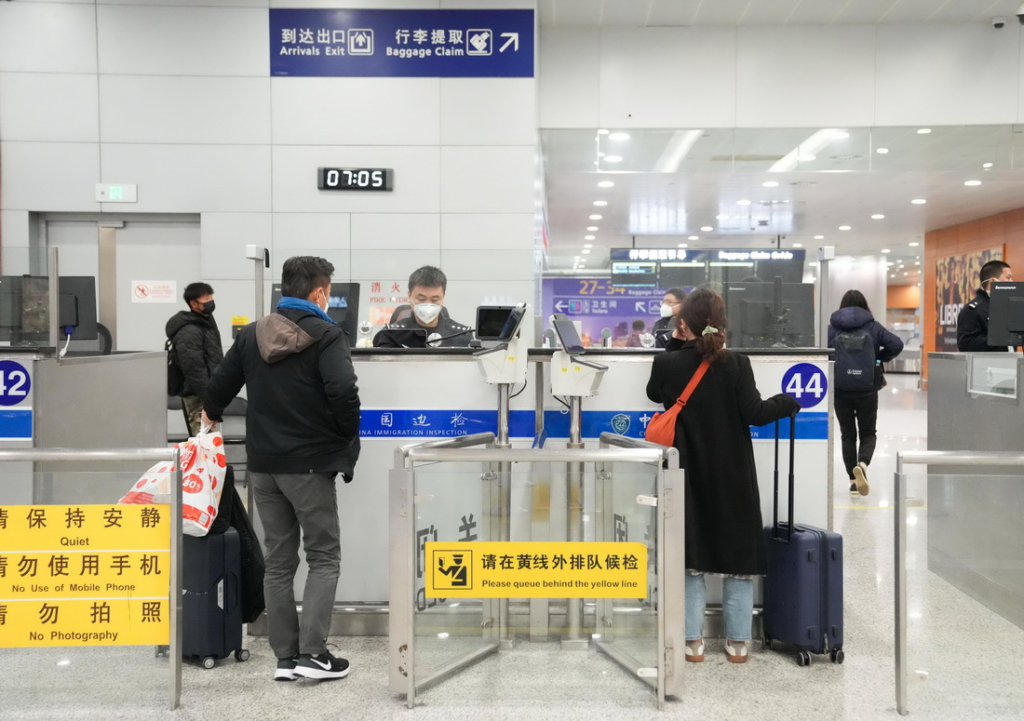
You land at Shanghai Pudong at 3 PM on a Tuesday. You hand over your passport. Then the officer scans it and takes your photo. Then comes the stamp, and a wave through. Overall, the whole thing takes about three minutes.
You are now legally in China for 30 days. There is no visa in your passport. In fact, we have watched this happen for clients dozens of times. Still, it really is that unremarkable.
2027 Status: What Changes on 1 January
Here is the honest answer as of 27 October 2026. China has not announced whether 30-day visa-free entry continues into 2027. The current notice covers 48 countries. Specifically, it ends at 24:00 on 31 December 2026. Until a new notice appears, nobody can promise visa-free entry in 2027. That includes airlines and travel agents.
Yet there is good reason to expect a renewal. China has extended this policy every year since it began. Originally it started as a six-country trial in December 2023. The last two extensions were both announced in November, on 22 November 2024 and 3 November 2025. The list also grew from 6 countries to 50 in that time. So a November 2026 notice fits the pattern. But a pattern is not a guarantee.
Meanwhile the traffic keeps climbing. China logged over 30 million visa-free entries by foreign nationals in 2025. That was up 49.5% year on year. In short, visa-free arrivals made up over 73% of all foreign entries. In the third quarter of 2026 alone, foreign nationals made 23.27 million border crossings. Specifically, 8.99 million were visa-free, or 77.5% of the total. Overall, a policy carrying three quarters of inbound travel rarely gets switched off quietly.
The Three Routes That Do Not Expire
Yet this is the part most guides miss. Suppose the 30-day policy lapses on 1 January 2027. Still, three other routes carry no end date. All three are unaffected.
- 240-hour visa-free transit. 57 countries, 10 days. No expiry is written into the policy. If you fly onward to a third country, this still works in 2027.
- Mutual visa exemption agreements. 29 countries. These are treaties, so they have no link to the unilateral deadline. Singapore, Thailand, Malaysia, the UAE and Kazakhstan are covered permanently.
- Hainan Island’s 30-day scheme. 61 countries, separate policy, still in force. You just have to stay inside Hainan Province.
So only the 48-country unilateral list hangs on a November notice.
If Your Trip Is in 2027: Three Ways to Protect Yourself
- First, book changeable flights and hotels. Free cancellation costs nothing. It also buys you the option to wait for the announcement. Do not lock in non-refundable February inventory in October.
- Second, check whether a transit route fits. Were you flying home via Tokyo, Seoul, Bangkok or Hong Kong anyway? Then rebook that connection. A route like USA to Shanghai to Tokyo becomes a legal 240-hour transit. The visa question disappears.
- Third, apply for the L visa if you cannot wait. A visa in your passport works whatever happens to the policy. Standard processing takes 4 to 7 business days. So a January trip needs the application in by early December.
Booking a guided trip with us for early 2027? We will flag the moment the announcement lands. Our China travel questions guide covers the other things first-timers worry about.
240-Hour Transit Visa-Free: 10 Days, No Application
Your country may not be on the visa-free list. You may still enter China without a visa. You only need to be passing through.
The 240-hour transit exemption replaced the older 144-hour policy in December 2024. It now covers travellers from 57 countries for up to 10 days. Vietnam and Kyrgyzstan joined on 20 August 2026. That took the list from 55 to 57.
Eligible Countries
The exemption covers ordinary passport holders from 57 countries.
Europe, 40 countries. For example, that includes the UK, France, Germany, Italy, Spain and the Netherlands. Russia, Ukraine, Serbia and Belarus are on it too. So are the Nordics, the Baltics and most of the Balkans. Then check the NIA list for all 40.
Americas, 6 countries: United States, Canada, Brazil, Mexico, Argentina, Chile.
Oceania, 2 countries: Australia, New Zealand.
Asia, 9 countries: South Korea, Japan, Singapore, Brunei, United Arab Emirates, Qatar, Indonesia, Vietnam, Kyrgyzstan.
Where You Can Go
Overall, the policy runs through 65 ports of entry across 24 provincial-level regions. Also, you can enter at one port and leave from another. You can also travel between provinces inside the permitted areas.
However, seven regions are not covered at all. They are Tibet, Xinjiang, Inner Mongolia, Jilin, Gansu, Qinghai and Ningxia. Entering any of them on a 240-hour transit is a violation. It is not a grey area.
In practice, most of the 24 regions allow the whole province or municipality. That covers Beijing, Shanghai, Jiangsu, Zhejiang and Fujian. It also covers Shandong, Hubei, Hunan, Guangdong, Shaanxi, Sichuan and Yunnan. A few allow only named cities, including Shanxi, Jiangxi, Guangxi and Heilongjiang. So check the city list before you book a hotel.
Core Requirements
- Confirmed onward ticket to a third country or region. You must fly into China. You must then fly out to a country that is neither your origin nor your home country. USA to Shanghai to Japan qualifies. USA to Shanghai to USA does not.
- Valid ordinary passport. It needs at least 3 months of validity from your arrival date.
- Onward ticket bought before check-in. The airline checks this at boarding, not when you land.
Now the good news for US citizens. The United States is on the 240-hour list. Fly from the US to a third country with a stop in China. You can then spend up to 10 days here visa-free. Your final destination just cannot be the US.
Also, Hong Kong, Macau and Taiwan count as separate destinations for transit. So Shanghai to Beijing to Hong Kong is a valid routing. Is your onward leg to Hong Kong? Confirm the current reading with your airline at check-in.
Example route. Land in Shanghai. Take the high-speed train to Hangzhou, about an hour. Visit Suzhou’s classical gardens, 30 minutes from Shanghai. Then fly out of Shanghai to Bangkok. All of it is legal under the 240-hour policy.
Time Calculation
First, your 240 hours start at 00:00 the day after you arrive. They do not start at your landing time. So arrive Monday at 10 PM and your clock starts Tuesday at 00:00. In practice that hands you close to 11 days on the ground.
Common Misconception
Wrong: “I’ll fly New York to Shanghai, then take my return flight back to New York.”
So that does not qualify. You must transit to a third country, not go home.
Right: “I’ll fly New York to Shanghai, then Shanghai to Tokyo.”
That qualifies. New York to Shanghai to Tokyo is valid third-country transit.
Countries with Mutual Visa Exemption
China also has mutual visa exemption agreements with 29 countries. These sit apart from the unilateral list. Under each treaty, both sides waive visas for the other’s citizens. Still, none of them carry the 2026 deadline.
Key Countries with Mutual Visa Exemption
| Country | Maximum Stay |
|---|---|
| Singapore | 30 days |
| Malaysia | 30 days |
| Thailand | 30 days |
| United Arab Emirates | 30 days |
| Serbia | 30 days |
| Belarus | 30 days |
| Mauritius | 60 days |
| Fiji | 30 days |
That is 8 of the 29. For example, the rest include Albania, Armenia, Azerbaijan, Georgia, Kazakhstan, Maldives and Uzbekistan. Some are small island states in the Caribbean and the Pacific. So check the NIA list for all 29.
Read the terms country by country. Most allow 30 days per entry. Several use cumulative limits instead, such as 90 days in any 180. Specifically, that group includes Albania, Armenia, Bosnia and Herzegovina, Georgia and Kazakhstan. Still, a country name alone is not enough to plan around.
Other Visa-Free Routes Most Travellers Miss
China also runs regional and group schemes. They solve the visa problem for specific itineraries. None of them depend on the November notice.
Hainan Island: 30 Days, 61 Countries
Citizens of 61 countries can enter Hainan Province visa-free for up to 30 days. Specifically, permitted reasons include tourism, business, family visits, medical treatment, exhibitions and sport. You must enter and exit through Hainan’s open ports. You must also stay inside the province. It is the easiest visa-free option for a beach trip. It is also completely separate from the mainland policy.
Cruise Groups, ASEAN Groups and 24-Hour Transit
- 15 days for cruise groups. Two or more passengers arriving by ship qualify. For instance, thirteen port cities take part, including Shanghai, Tianjin, Qingdao, Xiamen, Guangzhou, Shenzhen and Sanya.
- ASEAN tour groups, 6 days. Group tours from ASEAN countries get 6 days visa-free. Entry points are Xishuangbanna in Yunnan and Guilin in Guangxi.
- Hong Kong and Macau tour groups, 6 days. Foreign groups arriving via Hong Kong or Macau get 6 days. The area covers nine Greater Bay Area cities plus Shantou.
- 24-hour transit. In practice, every open port grants 24-hour visa-free transit. It is open to all nationalities. You need an onward ticket and you cannot leave the port area.
Tourist Visa (L Visa): When You Need One
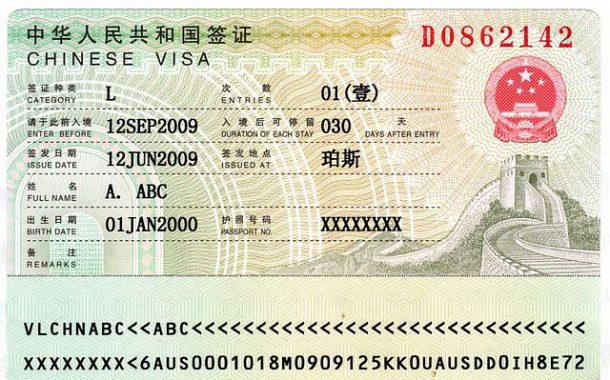
Three situations call for the L visa. Perhaps your country is on none of the lists above. You need to stay longer than 30 days. Or your 2027 trip is too close to risk a policy lapse.
When to Apply for an L Visa
- Your country has no visa-free or transit arrangement with China.
- You need more than the permitted visa-free period.
- A 2027 trip booked before the renewal notice needs certainty.
- Extended business visits also need one.
Types of L Visa
- Single Entry: one visit, up to 30 or 60 days, extendable in-country.
- Double Entry: two separate visits within 6 months.
- Multiple Entry: several visits within 6 to 12 months, for frequent travellers.
Where to Apply
The official portal is consular.mfa.gov.cn/VISA/. You submit through the Chinese embassy or consulate covering your country of residence.
Required Documents
- Passport: valid for at least 6 months, with 2 blank pages.
- Photo: 48×33mm, white background, taken in the last 6 months.
- Confirmed round-trip flight: not standby, not on hold.
- Hotel reservation: or an invitation letter from a Chinese host.
- Itinerary: a short plan of where you go and what you do.
Fees and Processing
- Visa fee: typically $50 to $140, by nationality, entry type and speed.
- Standard processing: 4 to 7 business days.
- Express processing: 2 to 3 business days for an extra fee.
Fees change and vary by country. So confirm the current figure with your local embassy or visa centre before you pay.
Step-by-Step: How to Apply for a Tourist Visa
Step 1: Determine Your Entry Method
Check whether you need a visa at all. Work down this list.
- Is your country on the 50-country list, and is your date safe? No visa needed.
- Is your country on the 57-country transit list? Are you flying to a third country? Use the 240-hour transit.
- Is your country on the 29-country mutual list? No visa needed.
- Are you visiting Hainan only? Use the 61-country Hainan scheme.
- None of the above? Apply for the L visa.
Step 2: Complete the Online Application
Then fill out Form V.1 on the official portal: consular.mfa.gov.cn/VISA/.
- Answer every question truthfully and completely.
- Double-check dates and passport numbers before submitting.
- Finally, print the confirmation page and the full form.
Step 3: Prepare Your Documents
- Valid passport, 6+ months, 2 blank pages.
- Photo, 48×33mm, white background, recent.
- Confirmed round-trip flight booking.
- Hotel reservation or invitation letter.
- Proof of financial means, sometimes requested.
Step 4: Submit Application and Biometrics
- So book an appointment at your nearest embassy, consulate or visa centre.
- Submit documents in person.
- Give fingerprints, unless you qualify for an exemption.
- Pay the application fee.
Step 5: Wait and Collect Your Visa
- Standard processing takes 4 to 7 business days.
- Then express processing takes 2 to 3 business days for an extra fee.
- Collect your passport with the visa inside.
- Check every detail before you leave the counter.
5 Mistakes That Get Your Visa Application Rejected
1. Photo Problems (Most Common)
Your photo must be exactly 48×33mm on a white background. Glasses, heavy shadows, cropped phone selfies and photos older than six months get rejected. So take a new one for the application.
2. Inconsistent Itinerary
In fact, entering through Shanghai and leaving from Beijing is fine for a tourist visa. However, the 240-hour transit is stricter. Your onward flight must go to a third country or region, not home.
3. Unconfirmed Return Flight
So you need a confirmed ticket. A booking hold or standby will not do. Itineraries marked “pending” or “on hold” are refused.
4. Passport Validity Issues
A tourist visa needs 6 months of validity from your entry date. Visa-free entry and 240-hour transit need 3 months. So renew first if you are anywhere close.
5. Applying from the Wrong Country
Apply at the embassy or consulate covering your country of residence. Living abroad on another passport? Then expect to show proof of legal residency.
Frequently Asked Questions
Will China still be visa-free in 2027?
Not announced yet. As of 27 October 2026, the 30-day policy for 48 countries ends at 24:00 on 31 December 2026. No 2027 extension has been published. China has renewed it every year since December 2023. The last two notices came in November. A decision is likely within weeks. Russia is already covered to 31 December 2027.
My trip is in January 2027 and the policy has not been renewed. What do I do?
Three options, easiest first. Check whether a 240-hour transit fits your route. Were you flying home via Tokyo, Seoul, Bangkok or Hong Kong? Reroute the connection and the visa question disappears. Next, check the mutual exemption list and the Hainan scheme. Finally, apply for the L visa. Standard processing takes 4 to 7 business days. Early December is a safe cut-off for January.
Can I extend my 30-day visa-free stay?
Generally no. In genuine emergencies you can apply at the local Entry-Exit Administration Bureau. Do it before your permitted stay expires. Approval is discretionary and not guaranteed. So plan within the 30 days.
What if my 240-hour transit flight gets delayed?
Contact Chinese immigration at your port of entry immediately. Do it before your 240 hours run out. A short extension is sometimes granted. Do not build a plan that depends on it. Always leave buffer time before the onward flight.
Do I need a visa for Hong Kong or Macau?
No. Hong Kong and Macau run their own immigration policies, separate from the mainland. Most nationalities can visit Hong Kong visa-free for 7 to 180 days. Macau gives 30 days. So your mainland status does not change that. Note the reverse is also true. A mainland visa does not get you into Hong Kong. Hong Kong visa-free access does not get you into the mainland either.
Can I enter from Shanghai and leave from Beijing on 240-hour transit?
Yes. Different ports of entry and exit are fine. Enter through Shanghai and fly out of Beijing. Or land in Guangzhou and leave from Hangzhou. You may cross all 24 permitted regions. Just stay inside their permitted areas.
Is the United States on China’s visa-free list?
No. US passport holders are not on the 30-day unilateral list. The United States is on the 57-country 240-hour transit list, though. That allows up to 10 days in China when you fly onward to a third country.
How early should I apply for a tourist visa?
At least 2 months before departure if your dates are fixed. That leaves room to fix a rejected photo or absorb a delay. It also means you do not rebook flights at the last minute. A 2027 trip booked before the renewal notice? Applying early is the cheapest insurance you can buy.
Want more China planning help? Read the 50 Chinese phrases that actually work and Is China Safe for Tourists? Or browse our China tours and private itineraries.
Last updated: 27 October 2026. Visa policies change often, and the 2027 renewal is still pending. Always verify current rules before booking. So check the National Immigration Administration or your nearest Chinese embassy.
National Immigration Administration of PRC — Entry and Exit Policy Interpretations.
Chinese Visa Application Service Center — Summary of Current Visa Policies, updated 8 September 2026.
Ministry of Foreign Affairs — Official Visa Application Portal.