You do not need to learn Mandarin to have a great trip to China. You need about fifty phrases. The Chinese phrases for travel below are the ones that change what actually happens to you: the difference between a plate of food you can eat and one you cannot, between a driver who takes you to your hotel and one who circles the block, between paying full price and paying a third of it.
Mandarin Chinese is the world’s largest language by total speakers, at roughly 1.2 billion people (Ethnologue 200). And yet, outside a handful of international hotels, you will meet far less English than that number suggests. In the 2025 EF English Proficiency Index, China ranked 86th out of 123 countries, with an average score of 464 against a global average of 488. City scores vary a lot: Hangzhou 515, Beijing 514, Shanghai 508 — but Chongqing sits at 460 (EF EPI 2025).
The gap is widening on the visitor side. In the third quarter of 2026, China recorded 8.99 million visa-free foreign entries — 77.5% of all foreign arrivals, up 24.1% year on year (Xinhua, citing the National Immigration Administration). More foreigners are arriving than at any point since 2019, and the language barrier is still the first thing most of them mention when they get home.
This guide is deliberately short on grammar and long on words you will use in the first hour. Everything is written in pinyin with tone marks, because you will be speaking, not reading. Each phrase comes with the situation it belongs to — and, where it matters, what happens if you get it slightly wrong.
The 12 Phrases That Cover Most of a Trip
If you memorise nothing else, memorise these. They handle greetings, prices, directions and payment — the four things that come up every single day.
| English | Chinese | Pinyin | Use it when |
|---|---|---|---|
| Hello | 你好 | nǐ hǎo | Walking into any shop, restaurant or taxi |
| Thank you | 谢谢 | xièxie | Constantly. It is the highest-return phrase on this list |
| Excuse me / sorry | 对不起 | duìbuqǐ | Bumping into someone, or opening a conversation |
| How much is it? | 多少钱? | duōshao qián? | Markets, taxis, anywhere without a posted price |
| Too expensive | 太贵了 | tài guì le | The standard opening move in any market |
| A bit cheaper | 便宜一点 | piányi yìdiǎn | Immediately after 太贵了 |
| I do not understand | 听不懂 | tīng bù dǒng | When the reply is a wall of sound |
| Do you speak English? | 你会说英语吗? | nǐ huì shuō Yīngyǔ ma? | Politely, before you start miming |
| Where is the toilet? | 洗手间在哪里? | xǐshǒujiān zài nǎlǐ? | Urgently, and often |
| No chilli | 不要辣 | bú yào là | Ordering food anywhere outside Guangdong |
| The bill, please | 结账 / 买单 | jiézhàng / mǎidān | End of every meal. 买单 is the casual version |
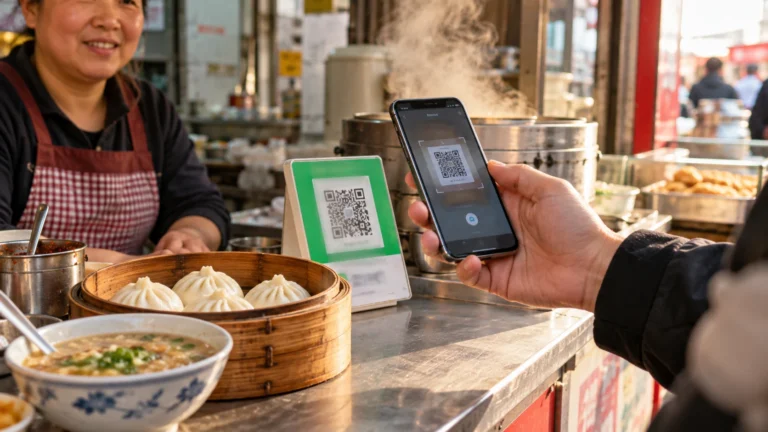
| Scan to pay | 扫码 | sǎo mǎ | Every counter in the country |
Two notes on how these land. First, 你好 is a greeting, not a conversation opener — Chinese speakers use it once and move on, so do not repeat it every time you make eye contact. Second, 太贵了 followed by 便宜一点 is not rude in a market; it is the expected script. In a shopping mall with printed prices, skip both.
How to Read the Pinyin in This Guide
Pinyin is Mandarin written in the Latin alphabet. It was designed to be readable by people who do not read Chinese, so the vowels work roughly the way you hope they do. The one thing you cannot ignore is tone.
The four tones in thirty seconds
Mandarin is a tonal language: the same syllable at a different pitch is a different word. The classic demonstration is ma:
- mā (first tone, high and flat) — mother
- má (second tone, rising) — hemp
- mǎ (third tone, dipping then rising) — horse
- mà (fourth tone, falling, like a firm instruction) — to scold
You will not master tones on a plane. You do not have to. Context does enormous work in Chinese, and a foreigner saying 谢谢 with the wrong tone will still be understood. But tones are why 买 (mǎi, to buy) and 卖 (mài, to sell) are not the same word, and why it is worth exaggerating the shape of each one rather than mumbling.
Two tone changes you will hear every day
Mandarin quietly rewrites itself in fast speech. Two rules cover almost all of it:
- 不 (bù) becomes bú before a fourth tone. So “no chilli” is bú yào là, not bù yào là.
- 一 (yī, one) changes tone depending on what follows. “One” before a fourth-tone word becomes yí, which is why “one portion” sounds like yí fèn.
You do not need to apply these rules consciously. You do need to know that the tone marks in this guide are the honest version, and that real speech will drift from them.
Restaurant and Food Phrases
Food is where phrasebook Chinese pays for itself. Menus are rarely translated, dish names are poetic rather than descriptive, and the two things most likely to ruin your meal — chilli and cilantro — are the two things nobody warns you about.
Getting a table and reading the menu
| English | Chinese | Pinyin |
|---|---|---|
| Table for two | 两位 | liǎng wèi |
| Menu | 菜单 | càidān |
| Do you have an English menu? | 有英文菜单吗? | yǒu Yīngwén càidān ma? |
| This one | 这个 | zhège |
| What is this? | 这是什么? | zhè shì shénme? |
| Delicious | 好吃 | hǎochī |
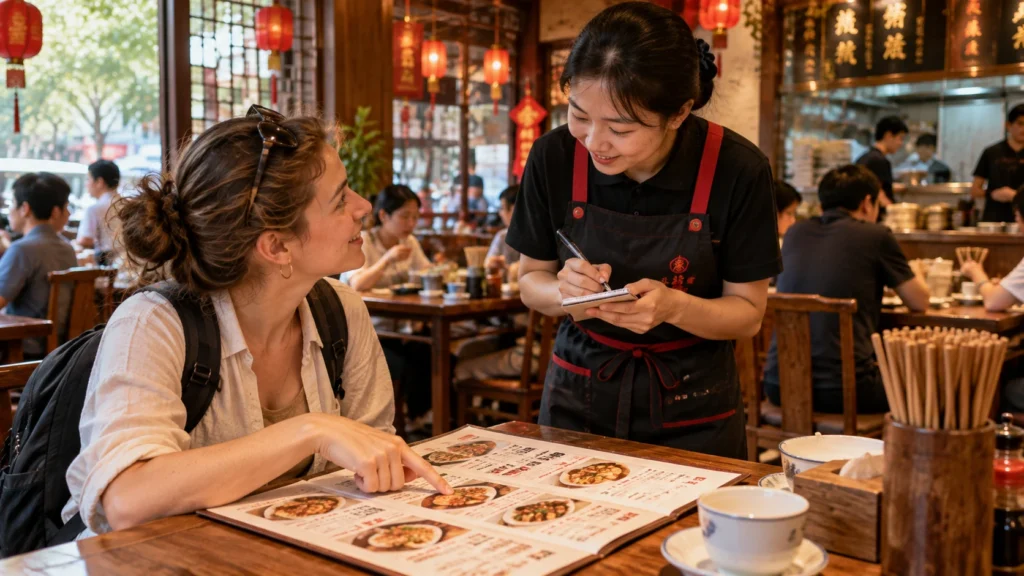
Pointing at a neighbouring table and saying 这个 is a completely acceptable ordering strategy in China, and often the best one. 这个 also works in markets, at food stalls, and at bakery counters. If you learn one phrase for eating, learn this one.
Allergies, spice and the cilantro problem
| English | Chinese | Pinyin |
|---|---|---|
| No chilli / not spicy | 不要辣 / 不辣 | bú yào là / bú là |
| Mild | 微辣 | wēi là |
| No cilantro | 不要香菜 | bú yào xiāngcài |
| No garlic | 不要蒜 | bú yào suàn |
| No vinegar | 不要醋 | bú yào cù |
| I do not eat meat | 我不吃肉 | wǒ bù chī ròu |
| I am vegetarian | 我吃素 | wǒ chī sù |
| I am allergic to peanuts | 我对花生过敏 | wǒ duì huāshēng guòmǐn |
| Hot water | 热水 | rèshuǐ |
| Tissues | 纸巾 | zhǐjīn |
An important warning about 微辣. In Sichuan and Hunan, 微辣 means “mild for a local”, which is still genuinely hot for most visitors. If you want food with no heat at all, say 不辣 and be prepared to repeat it. If you have a serious allergy, do not rely on a phrase alone — carry a written card in Chinese and have your hotel or guide confirm it with the kitchen. Translation apps handle ingredient lists badly, and “no peanuts” in a country that cooks with peanut oil is a conversation, not a word.
The cilantro line is the one travellers thank us for most. 香菜 appears in soups, noodles and stir-fries without warning, and there is no polite way to remove it once the bowl is on the table. Saying 不要香菜 at the moment of ordering is normal, expected, and never seen as fussy.
Paying and taking food home
- 结账 (jiézhàng) or 买单 (mǎidān) — “the bill, please”. In casual restaurants you usually pay at the till near the door rather than at the table.
- 打包 (dǎbāo) — literally “wrap it up”. Taking leftovers home is completely normal in China, and restaurants will hand you a box without a second thought.
- 干杯 (gānbēi) — “dry the glass”, the toast you will hear at every shared table.
- 不用了 (bú yòng le) — “no need, thanks”. Use it for the sixth offer of more food.
One cultural note: in many restaurants a single pot of tea or hot water is free and refilled without asking, and rice is often charged per person rather than per bowl. If you want to understand what you are eating before you order it, our guide to what to eat in China breaks down the dishes you will meet in each region.
Getting Around: Taxis, Trains and Asking Where Things Are
Transport is the second place where a few words save an hour. Drivers in China rarely speak English, and in a city like Chongqing the difference between two exits of the same station can be a twenty-minute walk.
| English | Chinese | Pinyin |
|---|---|---|
| Where is …? | … 在哪里? | … zài nǎlǐ? |
| Train station | 火车站 | huǒchēzhàn |
| Metro | 地铁 | dìtiě |
| Exit / Entrance | 出口 / 入口 | chūkǒu / rùkǒu |
| Please take me to this address | 请带我去这个地址 | qǐng dài wǒ qù zhège dìzhǐ |
| Stop here | 这里停 | zhèlǐ tíng |
| Left / right / straight ahead | 左 / 右 / 直走 | zuǒ / yòu / zhí zǒu |
| I want to get off | 我要下车 | wǒ yào xià chē |
The single most useful transport habit costs nothing: before you leave your hotel, photograph the front desk card or ask staff to write the address in Chinese and keep it on your phone. Handing a driver a screen is faster and more reliable than pronouncing a street name, and it removes the risk of a translation app inventing a destination that does not exist.

For long distances, the high-speed rail network is the reason most itineraries work at all — our high-speed train guide covers booking, station security and how early to arrive. You will also want the apps to install before you fly, since ride-hailing and translation both live on your phone.
Shopping, Money and the Two Words Worth 11%
China is close to cashless, and the payment phrases matter more than the bargaining ones. Two words in particular have a direct cash value.
| English | Chinese | Pinyin |
|---|---|---|
| Can I pay by card? | 可以刷卡吗? | kěyǐ shuākǎ ma? |
| Alipay / WeChat Pay | 支付宝 / 微信支付 | Zhīfùbǎo / Wēixìn zhīfù |
| Invoice / official receipt | 发票 | fāpiào |
| Tax refund | 退税 | tuìshuì |
| Any discount? | 打折吗? | dǎzhé ma? |
| Just looking | 我看看 | wǒ kàn kan |
Here is the one that pays. To claim China’s departure tax refund you need 发票 (fāpiào) — the official tax invoice, not the small printed slip most shops hand you by default. Ask for it at the till, with your passport, at the moment of purchase. You need to spend at least 200 yuan in the same store on the same day, and the refund rate is 11% on goods taxed at 13% (Guizhou Provincial Department of Commerce departure tax refund guide). On a 6,000-yuan camera that is real money. Our tax-free shopping guide walks through the airport steps, and how to pay in China covers the QR-code setup you need before any of it works.
The two words that get you out of a bad interaction are 不用了 (bú yòng le, “no need, thanks”) and 谢谢 (xièxie). Together they end almost any unwanted sales pitch without friction. If you want to shop seriously rather than casually, a market like Yiwu is a different sport altogether — our Yiwu wholesale market discovery day exists precisely because navigating it without a Mandarin speaker is exhausting.
When Something Goes Wrong: Health, Police and Emergencies
Nothing here is likely to happen. Everything here is worth twenty seconds of memory anyway.
| English | Chinese | Pinyin |
|---|---|---|
| Help! | 救命! | jiùmìng! |
| I need to see a doctor | 我需要看医生 | wǒ xūyào kàn yīshēng |
| Hospital | 医院 | yīyuàn |
| Pharmacy | 药店 | yàodiàn |
| Police | 警察 | jǐngchá |
| I lost my passport | 我的护照丢了 | wǒ de hùzhào diū le |
| Call an ambulance | 叫救护车 | jiào jiùhùchē |
Two practical details. First, 110 is the police number and 120 is the ambulance number — both work without a Chinese phone number, and both have English-speaking operators in major cities. Second, hospital registration desks in big cities increasingly have English signage and an international clinic, but a pharmacy (药店) is where you go for ordinary problems, and staff there will often use a translation app to ask what you need.
If your concern is general safety rather than language, the honest picture is that China is a low-crime country for visitors — our guide to whether China is safe for tourists covers the actual risks, which are mostly traffic and scams rather than violence.
Eight Phrases That Do Not Mean What You Think
This is the part no phrasebook tells you. Correct pronunciation is not the same as correct usage, and these eight come up in real conversations.
- 服务员 (fúwùyuán) — “server”. This is how you call a waiter in China. Waving and saying “excuse me” in English produces nothing; 服务员 across a room is normal and polite.
- 老板 (lǎobǎn) — “boss”. At a small shop or street stall, this is the standard way to get the owner’s attention, and it lands as friendly.
- 没有 (méiyǒu) — “we do not have it”. It is a fact, not a rejection. When a shop assistant says it, they are not being difficult; try the next shop.
- 不知道 (bù zhīdào) — “I do not know”. Often a reflex rather than a real answer, especially to a question in English. Ask someone else, ideally someone under 30.
- 差不多 (chàbuduō) — “more or less”. This is the answer you will get about walking times, distances and whether something is open. Treat it as an approximation, not a commitment.
- 可以 (kěyǐ) — “sure, that is possible”. Two syllables, endless uses: is this seat free, can I take a photo, can I pay here. It is the single most efficient word in this article.
- 加油 (jiāyóu) — literally “add oil”, actually “you can do it”. You will hear it at sports events and from strangers watching you carry a suitcase up a staircase. It is not about fuel.
- 欢迎光临 (huānyíng guānglín) — “welcome”. Staff say it at the door of every shop. It is not a question and does not require an answer, which surprises visitors who reply with a full sentence.
Do You Actually Need Chinese Phrases for Travel? The Honest Answer
Depends entirely on where you go and how you travel.
English works at airports, at international-brand hotels, in major museums with audio guides, on high-speed trains, and with younger staff in Shanghai, Beijing and Hangzhou. The EF city scores back this up: those three cities score 514, 514 and 508, comfortably above the national average.
English does not work in neighbourhood restaurants, at wet markets and food stalls, in most taxis, at train stations outside the biggest cities, in small-town pharmacies, and in any hospital that is not an international clinic. Chongqing’s score of 460 is a fair warning: it is one of the most rewarding cities in China for food and one of the least likely to hand you an English menu.
The official Chinese Proficiency Grading Standards put the elementary stage of learning at 2,245 words and 900 characters, with the first level alone set at 500 words and 300 characters (Ministry of Education, GF 0025-2021). That is the bar for living in the language. For a two-week trip, the fifty phrases in this guide do most of the same work — with one exception. If your itinerary leans on markets, street food, small towns or family-run guesthouses, a Mandarin-speaking guide is not a luxury, it is the difference between watching China and talking to it.
That is what our private day tours are built around: a local guide who orders for you, negotiates for you, and translates the parts of the country that have never been translated. The Xi’an city wall and food tour is the clearest example — you eat your way through the Muslim Quarter with someone who knows which stall is worth the queue. The Chengdu panda and hotpot day solves the same problem in the city with the most complicated menu in China.
How to Practise Before You Fly
Thirty minutes on the plane is enough. Four steps, in order of return on effort:
- Download Chinese offline in your translation app. Assume you will not have mobile data in the first hour after landing, before your eSIM activates. An offline language pack turns your phone into a phrasebook with no signal.
- Learn 谢谢 and 你好 until they are automatic. These two carry more goodwill than any other two words in the language, and they are the two you will use hundreds of times.
- Screenshot your hotel name and address in Chinese. Do this before you leave the hotel each morning, not after you are lost. It works with no battery-hungry app open and no data connection.
- Say the tones out loud once. Even badly. Speaking a phrase silently to yourself is the most common reason people freeze when a real person answers.
If you want the phone side sorted before you land, our apps checklist covers translation, maps, ride-hailing and payments in the order you will need them.
Common Mistakes to Avoid
- Speaking English more slowly and more loudly. It does not help. Point, or open a translation app.
- Assuming 是 (shì) means yes. It means “is”. Agreement is 对 (duì) or 好的 (hǎo de), and a nod is usually enough.
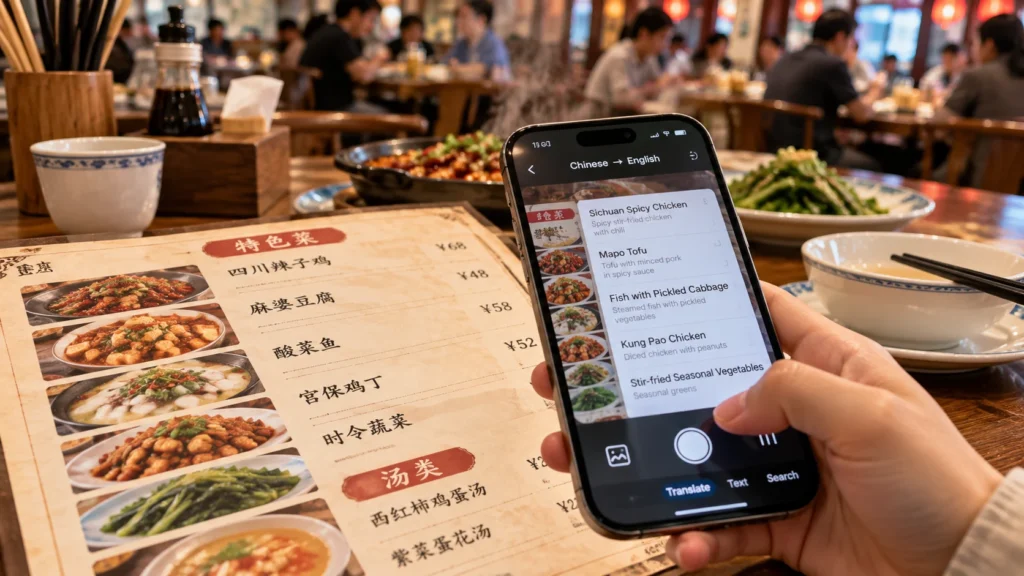
- Reading characters aloud from a menu. If you cannot pronounce it, you will not be understood. Show the phone or point instead.
- Trusting a translation app on dish names. Chinese dishes are named after poems, places and people. An app will happily tell you that a famous dish is “ants climbing a tree”.
- Forgetting the invoice. No 发票, no tax refund — and you cannot get one after you leave the store.
- Leaving the hotel without the address in Chinese. The most avoidable twenty minutes of any trip.
- Apologising for not speaking Chinese. Nobody expects you to. A smile and 谢谢 gets you further than an apology.
Quick Answers to the Questions People Search Most
Do I need to speak Chinese to travel in China?
No. Millions of visitors travel China every year without a word of Mandarin, and English gets you through airports, hotels, trains and major attractions. But the trip gets noticeably easier and warmer with fifty phrases, and in neighbourhood restaurants, markets and taxis it is the difference between guessing and knowing.
Is it rude if I do not speak Chinese?
Not at all. Nobody expects a foreign visitor to speak Mandarin, and locals are far more likely to be amused by your attempt than offended by your accent. What does read as rude is speaking English more slowly and more loudly, or refusing to engage at all.
What is the single most useful Chinese phrase for tourists?
这个 (zhège), meaning “this one”. It works at food stalls, in markets, at bakery counters and in restaurants with no English menu. Point at what you want and say it. The second most useful is 谢谢 (xièxie) — thank you.
How do you say thank you in Chinese?
谢谢, written in pinyin as xièxie. It covers thank you, thanks and cheers-for-that, and you will use it dozens of times a day. The standard reply you will hear back is 不客气 (bú kèqi), meaning “you are welcome”.
Can I use English in restaurants in China?
In hotel restaurants, international chains and tourist-heavy areas of Shanghai and Beijing, often yes. In local restaurants, almost never. Pointing at a dish, using a translation app on the menu, or having a guide order for you are all normal and unremarkable ways to handle it.
Plan Your Trip
Language is the smallest barrier in China and the easiest one to prepare for. Learn fifty words, keep your hotel address in Chinese, and the country opens up in a way that surprises first-time visitors. Where the phrases run out, a local guide takes over — and that is exactly what our day tours are for.
Start with the Shanghai Bund and old-city walk if you want an easy first day in a city where English gets you halfway, or go straight to the food cities with the Xi’an and Chengdu tours. Private day tours start from $49, with guides who speak the language so you do not have to.
Still deciding what to ask before you book? Our China travel questions people are too afraid to ask covers the practical worries — toilets, tipping, SIM cards, water — and our chinamaxxing guide is about living the trip rather than visiting it.