You probably found the idea the way most travelers do. A photo of the Forbidden City under fresh snow pops up in your Instagram feed. Harbin’s glowing ice castles are all over TikTok. And a headline says China now lets your passport in visa-free. So you open a map and start planning a Christmas trip. If you are visiting China in winter for the first time, that is exactly where the trouble starts.
Your feed shows the highlights reel of a country the size of a continent, and winter in China is not one story but three. The mistakes first-timers make before they even board are remarkably consistent:
- “Beijing in December must look like a snow globe.” A snow-covered Forbidden City is famous for a reason — it is rare. Most December days are clear, dry, and freezing, with no snow at all.
- “Surely every building is heated in winter.” Heating is guaranteed only in the north. Shanghai stays warm indoors, but some hotels and restaurants in Chengdu and Chongqing stay chilly inside.
- “Christmas must be huge in China.” December 25 is a normal working day. Yet Shanghai and Hong Kong throw some of the biggest Christmas markets in Asia.
- “How far apart can these cities really be?” The Beijing-to-Harbin train alone takes 5-6 hours, longer than London to Edinburgh.
This guide is written from the other side of those mistakes. It ranks every winter destination honestly and shows you how to build an itinerary that fits the real scale of the country.
Late December is also one of the smartest windows of the year for visiting China in winter. Sights are half empty, Chinese New Year price hikes have not started, and the trains run on time. You just need to match your expectations to the right region.
First, Understand China’s Three Winters
The single biggest planning error is treating cold as cold. China runs on three winter systems, and the low mountains of central China bend the rules.
- The north (Beijing, Xi’an): dry cold. Bright blue skies, around -2°C to -10°C in the daytime, and municipal heating in every building from November to March. You strip down to a sweater indoors.
- The northeast (Harbin): a different league. Days around -13°C, nights near -25°C, and snow that settles on the ground for months instead of melting in a day. Pack for serious cold.
- Central China (Shanghai, Chengdu, Chongqing) and its low mountains: damp cold. The cities show mild 4-13°C thermometers but humidity of 70-84% that cuts straight through clothes. China draws an official heating line along the Qinling Mountains and the Huai River, and cities south of it have no municipal district heating. Shanghai’s malls, hotels, and subways stay warm, but some guesthouses and local eateries in Chengdu and Chongqing stay chilly inside, so check heating reviews. The region’s low mountains bend these rules further. Huangshan in Anhui and Zhangjiajie in Hunan run far colder, foggier, and icier than the cities at their feet.
- The warm south (Hong Kong, Sanya) and Yunnan’s highlands. Hong Kong sits around 18-20°C, Sanya around 25°C, while Dali and Lijiang reach 15-18°C under strong sun.
Which Winter Do You Want? Pick Your Cities
Here is every city worth considering, grouped by the kind of winter it actually delivers. Pick the group that matches what you want, rather than stitching famous names onto a map.
Dry Cold and the Classics: Beijing and Xi’an
Beijing and Xi’an deliver the classic northern Chinese winter. Expect sharp, dry cold under bright blue skies, with every building heated to roughly 20°C. Days run around -2°C to -10°C and nights near -10°C. Think Montreal in January, not London in November.

What about the snow? This is where expectations hurt most. Fresh snow over the Forbidden City’s golden roofs or Xi’an’s city wall is one of the most photographed scenes in China. It is also mostly a matter of luck. Clear, dry, freezing days are the norm. Treat heavy snow as a rare bonus, not a plan, and go for the empty sights instead. The Forbidden City, the Great Wall, and Beijing’s hutongs are half as crowded as in spring. The Shichahai outdoor ice rink opens in late December, and copper-pot mutton hot pot tastes best in crisp air. For the best winter wall experience, our wild-wall hike along Gubeikou to Jinshanling gives you the ridge in clean cold air with almost no crowds.
Xi’an pairs naturally with Beijing. The Terracotta Warriors sit indoors and look identical in December. The city wall is glorious on a clear cold day, and the Muslim Quarter food stalls steam in the cold. Expect dry cold and blue sky — not snow.
Guaranteed Snow: Harbin and the Northeast
If snow is the whole point of your trip, only China’s far northeast is a sure bet. Harbin sits in a colder league than Beijing, with days around -13°C and nights near -25°C, and snow that settles for months. Its Ice and Snow World is a city of carved, illuminated ice from the frozen Songhua River. It opens for trials around December 20 and runs in full from early January. You have almost certainly seen it on social media, and for once the videos do not exaggerate.
Know what you are signing up for. Harbin is an expedition, not a casual add-on. The train from Beijing takes 5-6 hours, and English is limited outside the main sites. Foreigners usually queue in person with passports for Ice and Snow World tickets. It is doable without Chinese, because the festival area carries English signs and ride-hailing apps have English versions. Even so, build extra time into ticket counters, and pack for -25°C rather than for Beijing.

The ice festival is the headline, but most foreign visitors add two side trips. Yabuli is about 1.5 hours by high-speed train. It is China’s largest and oldest ski resort, host of the 1996 Asian Winter Games, with rentals, beginner lessons, and gentle slopes. First-timers and families love it. If you ski the Alps or the Rockies every year, treat Yabuli as a fun novelty, because the runs are short by international standards.
China Snow Town (Xuexiang) is the logging village near Mudanjiang you see all over social media. Snow piles two meters deep into “snow mushrooms” on the wooden cabins. The honest catch: it is China’s most commercialized winter village. Pricing runs on fixed packages, and homestays can triple in price around Chinese New Year.
The good news is that the same deep, sticky snow covers nearby villages that stay almost untouched. Snow Valley (Xuegu) sits on the far side of the same Yangcao Mountain. Entry is free. Farmhouses offer heated kang beds at local prices, and the village is the classic trailhead for the 15km ridge trek over to Snow Town. Erlanghe, a 64-cabin log village on the Yabuli-to-Snow Town road, is also free, with rime forests and quiet lantern-lit nights.
A quieter northeast alternative is Changbaishan, on the border with North Korea. It is barely known among Western travelers yet, though Russians and Koreans visit in numbers, and it offers China’s most polished ski-resort town. The Wanda resort runs 40-plus trails from mid-November to early April, with Club Med, Park Hyatt, and ski-in hotels. The signature moment is volcanic. Soak in an outdoor hot spring at -20°C while your hair freezes, boil eggs in the Julong hot spring, and catch rime along the unfrozen river. The frozen Heaven Lake crater is stunning when visible, but winter wind often closes the summit road, so treat it as a bonus. It works as a 2-3 night resort add-on, or paired with Harbin on a longer northeast loop.
A Warm Winter: Yunnan, Hong Kong, and Sanya
If you want winter atmosphere without the cold, three mild options sit in the south and southwest.
Yunnan runs on a dry, sunny highland winter. In Dali and Lijiang, December days climb to 15-18°C under strong sun, warm enough for a sweater or light jacket, while nights cool to a few degrees. November to April is the dry, clear season. Winter-only moments include red-billed gulls wintering on Dianchi Lake in Kunming and Erhai Lake in Dali from November to March, and the flooded Yuanyang rice terraces from December to February. Yunnan drew over 990,000 inbound arrivals in the first eight months of 2026, and it was China’s sole entry on The New York Times “52 Places to Go” list for 2026 (China News Service, 2026).

Three honest caveats. Altitude only matters in the far northwest. Dali sits around 2,000 meters and Lijiang around 2,400, and most travelers feel nothing. Shangri-La climbs to 3,300 meters, the Deqin and Meili Snow Mountain area goes higher, and the Yulong Snow Mountain cable car above Lijiang reaches 4,506 meters. Take it slow up there, and skip the cable car if you have heart or lung problems. The bigger catch is distance. The highlights sit three to six hours apart by road or rail, so a week in Yunnan covers far fewer places than a week around Shanghai. Pack a real coat too, because warm days turn cold after dark.
Hong Kong is the answer if you want Christmas spirit without the cold. December brings 18-20°C days, low humidity, and clear skies, so pack long sleeves and a light jacket rather than shorts. Victoria Harbour lights up for the season, the West Kowloon Cultural District runs a European-style Christmas market, and the shopping districts hold holiday sales. December also opens Hong Kong’s best hiking season, from November to April. The MacLehose Trail Stage 2 is a roughly 13.5km walk past four sweeping beaches, and the shorter Dragon’s Back ridge walk takes half a day. One logistics point: Hong Kong is a separate immigration zone from mainland China, so crossing counts as a border check. Many travelers finish a mainland trip with two or three mild days here before flying home.
Sanya on Hainan Island stays around 25°C and keeps its beach resorts open all winter. In the first half of 2026, its airport port processed over 630,000 border crossings, up 33%. Foreigners made up 83% of that total, and visa-free arrivals accounted for 97% (Sanya Municipal Government, 2026). It is China’s only true tropical coast, at the same latitude as Hawaii, and December to February is its best season. Expect dry, sunny 21-27°C days while most of China is gray and cold. It is the one place in the country where you can swim in the sea in December. Beachside music festivals and New Year fireworks make the year-end feel like a real holiday. The move most travelers miss is the contrast trip: Harbin snow followed by two or three Sanya beach days, all inside one visa-free visit.
Your Entry City: Shanghai and Christmas
Most international flights route through Shanghai, so expect to spend a night or two here. December runs 4-12°C with damp wind, and the riverside Bund feels colder off the water. The good news is that Shanghai’s malls, hotels, and subway cars are well heated, so you are often warmer indoors than outside. Pack a windproof coat for the streets and choose a hotel with strong heating reviews.
Is Christmas even celebrated in China? Officially, no, and December 25 is a working day. But Shanghai hosts the most convincing Christmas atmosphere in the country, genuinely European rather than decorative. The German Christmas market at the Rockbund near the Bund runs through December with wooden chalets, mulled wine, and gingerbread against historic stone buildings. Paulaner’s North Bund market serves glühwein facing the Lujiazui skyline, Xintiandi and the French Concession light up with tall trees, and Shanghai Disneyland runs artificial snow on Mickey Avenue.
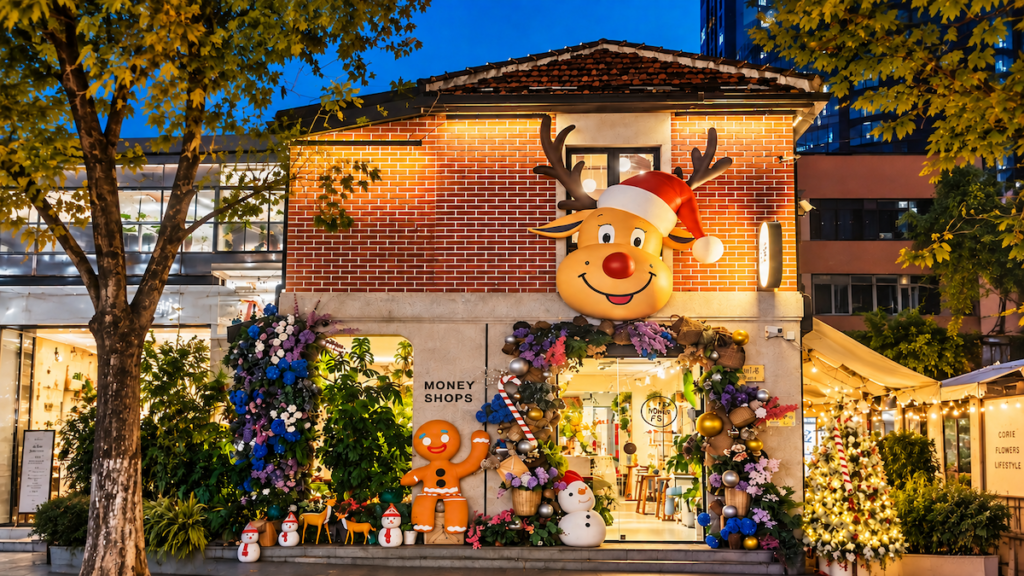
There is a local twist too. On Christmas Eve, young Chinese gift apples to each other, because the word for Christmas Eve (ping’an ye) shares its first sound with the word for apple (ping guo). Fancy gift-boxed apples appear in every convenience store around December 24, and joining in costs about two dollars. Spend December 24 and 25 in Shanghai rather than in transit. Our 7-day Shanghai, Suzhou, Hangzhou and Huangshan itinerary is built around this flow, and the Bund city walk covers the waterfront in half a day.
Wet-Cold Food Cities: Chengdu and Chongqing
Chengdu and Chongqing sit on the same damp system as Shanghai, but grayer and with less reliable indoor heating. December brings humidity around 80-84%, overcast skies, drizzle in Chengdu, and the famous fog in Chongqing. Do not expect snow, and do expect to keep your coat on inside some local restaurants and budget guesthouses. Pick accommodation with heating reviews, and treat hot pot as heating you can eat.
The payoff is food and mood. In Chengdu, the pandas are at their most active in cool weather, and two mountain day trips add snow without a flight. Mount Emei, about 1.5 hours by high-speed train, is the better-known classic. Its Golden Summit often sits above a frozen sea of clouds with rime on the pines. Off-season tickets run from mid-December to mid-January, and hot-spring hotels wait at the base. Xiling Snow Mountain, two hours west, runs southern China’s largest ski area, with gentle beginner slopes and hot-spring hotels below. Reliable snow usually waits until late December.
In Chongqing, go in with honest expectations. December is the foggiest month, so grand hilltop panoramas from Nanshan can vanish for days. The neon of Hongya Cave shining through the mist, though, is exactly the cyberpunk night shot winter photographers chase. Treat the skyline as a bonus and the hot pot as the plan. Our 5-day Sichuan and Chongqing itinerary covers the full winter loop.
Central China’s Winter Mountain: Huangshan from Shanghai
One mountain in the central belt is a genuine winter highlight rather than a gamble. If you enter through Shanghai and like landscape photography, Huangshan (the Yellow Mountains) is winter’s best-kept secret. After a snowfall clears, the granite peaks break through a sea of clouds and rime ice coats every pine. Winter produces the most reliable cloud-sea displays of the year, with a fraction of autumn’s crowds.
One correction to the usual hype: the snow is better than Beijing’s gamble but still not guaranteed in December. Heavy snowfall is most reliable in January. December’s dependable draws are rime ice on the pines, seas of clouds, and nearly empty trails.

The mountain is about 2.5 hours from Shanghai by high-speed train plus a short shuttle, so a 2-day trip bolts easily onto your entry city. Winter tickets drop to about 150 yuan from 190. Two honest warnings. The West Sea Grand Canyon and its scenic monorail close from December through mid-March, so summer trail maps will mislead you. The summit hovers around freezing in December, and cold snaps can push it to -10°C, with iced stone steps. Buy cheap crampons at the mountain base and stick to the classic cable-car loop. Our guided Huangshan 2-day tour from Shanghai handles the logistics, and the full Huangshan travel guide maps the winter-safe route.
A Winter Pleasure: Hot Springs and All-Day Spa Halls
Two cheap Chinese rituals surprise first-time visitors. Resort hot springs here run on a scale rarely seen abroad. A typical resort spreads dozens of outdoor pools across a hillside, each with a different temperature or herbal theme. You wear swimwear and go as a family, unlike the small, quiet baths of Japan. In winter the best ones come with snow around the pool, from the volcanic springs at Changbaishan to Emei and Xiling near Chengdu. Soaking outside in freezing air while your hair turns white is the classic photo.
Even more viral is the urban soup-spa hall, or tangquan. For roughly 15 to 50 dollars you get up to 24 hours in one giant complex. Inside are hot pools, saunas, fruit and ice-cream buffets, game rooms, cinemas, karaoke, massage, and sleep pods, with pajamas provided. National Geographic called China’s round-the-clock spas the year’s hottest new travel trend (National Geographic Traveller, 2026). Chengdu, Shenyang, Beijing, and Shanghai have the best ones. On a drizzly Chengdu afternoon or a freezing Harbin night, it is the coziest half-day in China, and sleeping there can beat a hotel on price.
Famous Spots Where Winter Is Not the Best Season
Not every famous mountain is at its best in December. These spots dominate English-language travel blogs all year, which is exactly why first-time visitors arrive with the wrong expectations. They are not bad places. They are simply far better in other seasons, so if your heart is set on them, timing matters more than luck.
Zhangjiajie is the clearest example. Downtown runs 5-12°C in December, but the pillar-top platforms above 1,000 meters sit 5-8 degrees colder, with nights around freezing. Its sandstone pillars are magnificent when visible, but December brings frequent fog. When the cloud rolls in, the famous pillars vanish into a white wall for hours. Glass walkways can close for ice, and cable cars stop in low visibility. Keep the constant-temperature Yellow Dragon Cave as a backup, and do not pin everything on one viewpoint morning. Zhangjiajie is at its best in autumn, when the pillars sit in clear light.
Jiuzhaigou offers half-price tickets, tiny crowds, and frozen waterfalls. Days range from about -3°C to 9°C and nights can fall below -10°C, yet the park only sees snow on 4 or 5 December days. Arrive early in the month and you may get bare brown branches instead of a snow-dusted wonderland, and some upper valleys close. Autumn is the season that made Jiuzhaigou famous, when the lakes mirror red and gold forests in October and early November.
Guilin and Yangshuo are best skipped in winter, and not because of cold: days still reach 15-17°C and nights sit around 8°C. The Li River is at its lowest, long cruises shorten or pause, and the karst peaks lose their lush green. Mild days make cycling pleasant, but the signature river scenery is simply not at its best. Save this one for spring, summer, or early autumn.
Pacing: How Many Cities You Can Actually Enjoy
Over-stuffing an itinerary when visiting China in winter usually starts with the map. China is the size of a continent. The train from Beijing to Xi’an takes 4.5-6 hours, and Beijing to Harbin takes 5-6. On top of the scale, cold weather slows everything down. A few rules keep the trip enjoyable:
- Give every city at least 3 nights. Arrival and departure days are half-lost to travel.
- Cap a 10-day trip at 3 cities. Fewer, longer stays beat rushed hops.
- Keep December 24 and 25 in one place. Pick Shanghai or Hong Kong for the atmosphere, and do not schedule a transfer on Christmas Day.
Pick the city group that matches the winter you want from the sections above, apply these three rules, and the route largely writes itself.
Practical Tips for Visiting China in Winter
Dates and Trains
Christmas is not a Chinese public holiday. Sights stay open and trains run normally, with no price spike around December 25. January 1 is a public holiday, so expect a small bump around New Year’s Eve. The real pressure is chunyun, the Chinese New Year travel rush that builds from mid-January. Late December is the sweet spot: the Harbin ice festival has just opened, and the rush has not started. High-speed train tickets release 15 days before departure on 12306, so book Beijing-Harbin trains early.
Apps and Payments: Set Up Before You Land
Install an eSIM and a VPN before you fly, because VPN downloads themselves can be blocked once you land. Bind a foreign bank card to both Alipay and WeChat Pay, since mobile payment is the default almost everywhere. Our China eSIM guide and guide to paying in China walk through the setup.
Packing for the Cold
The single most important upgrade for a northern trip is a power bank plus pocket warmers. Smartphone batteries drain fast in -15°C to -25°C air, and phones can shut down outdoors.
- Beijing and Xi’an: a down jacket, thermal layers, hat, gloves, and thick socks, worn in layers so you can strip down indoors.
- Harbin: the same, plus thermal boots, a face covering, and hand warmers. Treat -25°C seriously.
- Shanghai, Chengdu, and Chongqing: a windproof, water-resistant coat plus layers you can wear indoors, where heating may be weak.
- Huangshan and winter mountains: crampons for icy steps, cheaply available at the base, plus gloves and a windproof shell.
- Hong Kong, Sanya, and Yunnan: light layers, sun protection, and one jacket for cool evenings. Yunnan is strong sun by day and cold after dark.
Common Questions About Visiting China in Winter
Is winter a good time to visit China?
Yes, if you pick the right region. Late December brings half-empty sights, lower prices than autumn, and trains that run on time. Harbin guarantees snow, Shanghai delivers real Christmas atmosphere, and Yunnan and Hong Kong stay mild. The only mistake is expecting the same weather everywhere.
Does it snow in Beijing and Shanghai in December?
Not reliably. Beijing sees mostly dry, clear, freezing days, and heavy snow on the Forbidden City is a lucky bonus. Shanghai is damp and grey at 4-12°C and almost never gets settling snow. If guaranteed snow matters, go to Harbin or the ski resorts near it.
Can foreigners visit China visa-free around Christmas?
Many nationalities can enter visa-free for 30 days, and China has expanded transit and unilateral visa-free policies for major Western countries. Check the latest rules for your passport before booking, because the list keeps growing.
Plan Your Winter China Trip
Visiting China in winter rewards travelers who plan for the real season rather than the postcard one. Choose your kind of cold, bet on snow only where it is guaranteed, spend Christmas somewhere with actual atmosphere, and leave room to slow down.
If you would rather have a local build this around your pace and dates, our trip designers can put together a custom winter itinerary. Choose a dry-cold Beijing and Xi’an classic, a Shanghai-and-Huangshan photography loop, or a cold-north-to-warm-Hong Kong finish. For more seasonal help, our month-by-month best-time guide breaks down every season.