This guide is for your first trip to China — for the moment you sit down, open a menu printed entirely in Chinese, and watch your appetite turn to panic. Deciding what to eat in China should be the best part of your day, not the most stressful. Here is the handbook we wish we had carried: how to order without an English menu, what to expect region by region, what street food is safe, and how to pay.
Two things to unlearn before you land. The “Chinese food” you know from takeout boxes — General Tso’s chicken, fortune cookies, neon sweet-and-sour pork — is an overseas invention that barely exists in China, and the real dishes taste nothing like it. Nor do you need the “eight great cuisines”: that is how food writers organize cookbooks, not how a hungry traveler picks dinner.
You need two questions. One: what flavor region am I in? — plainly, will the food here be spicy? Two: what kind of meal is this? — a street breakfast, a one-bowl noodle lunch, or a group hot pot dinner? The first half of this guide is a flavor map for every city on a typical route; the second is a situation-by-situation playbook. A 15-city cheat sheet near the end does the rest: find your city, read one row, order with confidence.
Why Food Is the Best Part of Traveling in China
Ask any traveler back from China what they remember most, and the answer is usually not a temple. It is a meal: the 12-yuan noodle bowl that beat every fancy dinner, the night market stumbled into at 10 p.m., the three-hour hot pot session.
The numbers back this up. A China Tourism Research Institute survey found that 93.1% of inbound travelers listed experiencing local food as a main part of their trip (People’s Daily Overseas Edition, August 18, 2026). The trend even has a name — “Chinamaxxing,” younger Western travelers living like locals, eating at the center — and related hashtags passed 4 billion views in mid-2026 (CCTV News, July 29, 2026).
Food is also the cheapest deep-dive into the culture: a 15-yuan bowl of Lanzhou beef noodles plugs you into a centuries-old Hui Muslim tradition.
The Flavor Map: Forget the Eight Cuisines
Forget the textbook cuisine lists — what changes city to city is the flavor profile of everyday food. Five regions cover nearly every stop on a typical route, plus two coastal cities. One rule works everywhere: ask for *bu la* (not spicy) or *wei la* (mild).
Spicy and Numbing — Chengdu and Chongqing (麻辣, mala)
Sichuan cooking is built on mala: *ma* is numbing — Sichuan peppercorn, a rust-colored husk that tingles your lips like a mild electric buzz — and *la* is spicy. It is a sensation, not heat, and most people crave it after a meal or two. Chengdu is the capital: try mapo tofu (silken tofu in bubbling chili-bean sauce), dan dan noodles, and hot pot. Chongqing eats hotter and oilier — its hot pot is the fiery benchmark, and *xiaomian* spicy breakfast noodles are a daily ritual.
Spice tip: you control the dial. Say *wei la* or *bu la*, and order a yuanyang pot split between spicy red and plain white broth; “mild” in Chengdu is still hot, so start at *bu la*. See our Chengdu travel guide and 3-day Chongqing itinerary.
Fragrant-Hot, Not Numbing — Changsha and Guizhou (香辣, xiangla)
Hunan food (Changsha its capital) is often mistaken for Sichuan. The difference: no peppercorn numbing — just straight chili heat plus garlic, smoked meats, and fermented flavors: smoked pork with long beans, fish head under chopped salted chili (*duojiao yutou*), spicy crayfish in summer. Next-door Guizhou goes sour-spicy — *suantang yu* sour soup fish, more sour than hot. If you like hot sauce but not the tingle, this is your region.

Light, Sweet and Umami — Shanghai, Suzhou, Hangzhou and Guangzhou
If your heat tolerance is low, relax: a huge swath of China cooks gently. Shanghai and the Yangtze Delta (Suzhou, Hangzhou) lean subtly sweet-savory — soy-braised pork belly (*hongshao rou*), sweet-and-sour spare ribs, soup dumplings (*xiao long bao*); sugar here is a seasoning, not dessert. Guangzhou and the Cantonese south go the other way: freshness and umami above all, sauces light so the ingredient speaks — silky rice noodle rolls (*cheung fun*), crystal shrimp dumplings, slow-simmered soups. If mala is a rock concert, Cantonese cooking is acoustic: safest for cautious eaters. Our 3-day Shanghai itinerary covers the dumpling trail.
Hearty Wheat Country — Beijing, Xi’an and the North
Northern China runs on wheat, not rice: noodles, dumplings, buns, lamb — salty and savory rather than spicy, portions large. Beijing’s signatures: Peking duck and *zhajiangmian* (thick noodles with fried soybean paste and pork). Xi’an, the old Silk Road capital, is the highlight: *roujiamo* (slow-braised pork in a crisp flatbread — China’s hamburger), belt-wide *biangbiang* noodles, and *yangrou paomo*, where you tear bread into your bowl and the kitchen floods it with lamb broth; halal lamb cooking runs through the Muslim Quarter. Our 3-day Beijing itinerary and Xi’an travel guide cover the essentials.

Sour-Spicy and Ethnic — Kunming, Dali and Guilin
The southwest border provinces mix Han cooking with minority traditions: wild mushrooms, herbs, rice noodles, bright sour notes. Yunnan (Kunming, Dali) is China’s foraging capital — wild mushrooms in summer (in restaurants only, never foraged yourself), crossing-the-bridge rice noodles (*guoqiao mixian*, paper-thin ingredients cooked in broth at your table), grilled tofu. Guilin and Yangshuo do rice noodles for breakfast and beer fish — river fish braised in local beer — for dinner; the Guilin chili comes on the side. See our Yangshuo and Guilin guide.
Coastal Seafood — Qingdao and Xiamen
Two port cities worth noting: Qingdao pairs dockside seafood — clams, oysters, prawns — with Tsingtao beer; Xiamen does Fujian-style oyster omelets, satay noodle soup (*shacha mian*), and seafood congee. Both are mild. One rule everywhere: pick from the tank, point, pay by weight, confirm the price first.
How to Eat by Situation
These six eating scenes repeat in every city — flavor tells you what to expect, situation tells you how to order.
Breakfast Like a Local
Chinese breakfast is savory and fast. The universal four: warm soy milk (order sweet) with youtiao, a long fried dough stick to tear and dip (about 6 yuan); baozi steamed buns stuffed with pork or sweet red bean paste — point at the bamboo steamer, two or three make a meal; jianbing, a griddle crepe with egg and cilantro wrapped around a crispy cracker; and zhou (congee), rice porridge with pickles, the gentlest start for a jet-lagged stomach. Order by pointing, holding up fingers, and scanning the QR code.

The Noodle Shop: Your One-Bowl Safety Net
When you are alone, tired, or language-exhausted, find a noodle shop: one bowl, one price (usually 10–25 yuan), no decisions. Lanzhou hand-pulled beef *lamian*, Xi’an *biangbiang* noodles, and Guilin rice noodles cover the country north to south. The move that never fails: point at what the next person is eating, hold up one finger, then copy their pickles, peanuts, and chili oil from the topping bar. Halal Lanzhou chains (look for the halal sign) are everywhere and consistent.
Hot Pot and BBQ: The Group Rituals
Hot pot is China’s number one social meal: a bubbling pot in the middle, raw plates around it, everyone cooking and talking for two hours.
1. Choose the broth. Yuanyang (split: half spicy, half mild bone or tomato) is the standard visitor order. 2. Order raw plates: sliced beef and lamb, meatballs, tripe (swish 15 seconds only), lotus root, potato, tofu skin, mushrooms, greens. Two people: four or five plates plus noodles — plates are small. 3. Build your dip: sesame paste + garlic + cilantro + a little soy sauce; chili oil is there if you want it. 4. Cook in order: thin meat first (it floats when done), roots and tofu next, greens last.
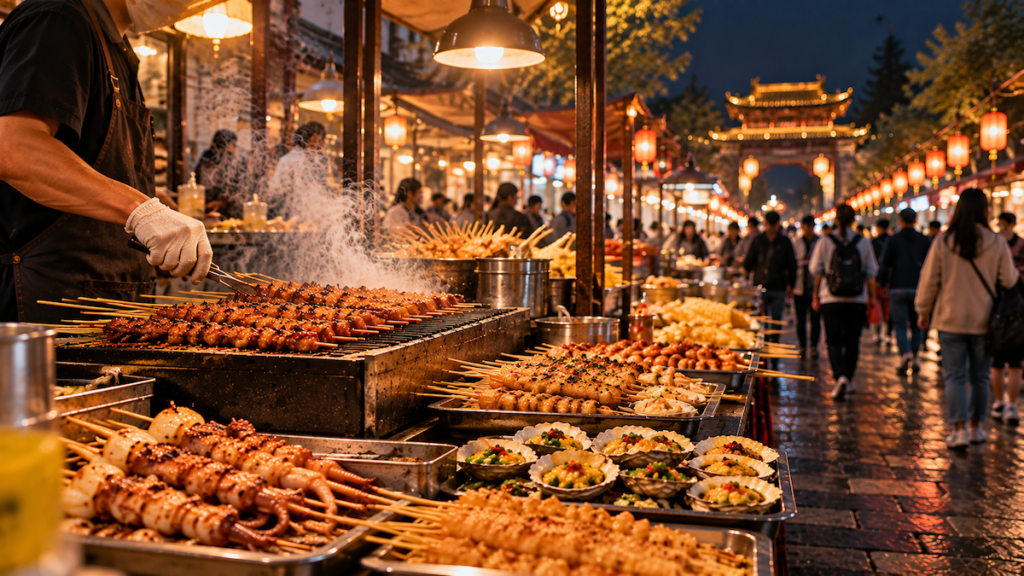
BBQ skewers (*kao chuan*) are the night version at night-market stalls — point at the display for lamb, chicken wings, eggplant, grilled buns, or leeks; ten skewers plus a beer is a normal order.
Night Market Street Food
Night markets are the loud, smoky, cheap heart of Chinese eating after 8 p.m. One rule: eat food cooked in front of you, served hot, from a stall with a line. Reliable hits: stinky tofu (smells like aged cheese, tastes like crunchy savory tofu — try it once), *roujiamo* burgers, *tanghulu* candied hawthorn skewers, roasted sweet potatoes, grilled squid. Skip pre-cut fruit sitting out, raw shellfish with no ice, and anything lukewarm. A long line of locals means fast turnover — join it.
Dim Sum: Cantonese Morning Tea
In Guangzhou (and Hong Kong), breakfast expands into a two-hour teahouse event called *yum cha* — tea with small steamed dishes. Bamboo baskets arrive in waves: *har gow* shrimp dumplings, *siu mai* pork cups, *cheung fun* rice noodle rolls, *char siu bao* BBQ pork buns, egg tarts. Most places use a paper order card — tick boxes, write quantities; older teahouses push carts, and pointing at one is fine. Go before 10 a.m., when baskets are freshest; tap two fingers on the table when someone pours your tea — the quiet Cantonese thank-you.

Sweets and Drinks
China’s sugar life happens between meals. Bubble tea (*naicha*) shops sit on every block — kiosks often have English; pick a tea base, sweetness (half sugar is a safe first order), and ice level. Other favorites: Cantonese *tong shui* dessert soups (mango pomelo sago, black sesame), thick Beijing yogurt in ceramic pots, fresh sugarcane juice in the south.
City Cheat Sheet: 15 Cities at a Glance
Spice level runs 0 (none) to 5 (mala heartland). Levels describe the local default — you can always order down.
| City | What to try | Flavor region | Spice level |
|---|---|---|---|
| Beijing | Peking duck, zhajiangmian, jianbing | Hearty wheat | 1 |
| Shanghai | Xiao long bao, shengjian bao, scallion oil noodles | Light & sweet | 1 |
| Xi’an | Roujiamo, biangbiang noodles, yangrou paomo | Hearty wheat | 2 |
| Chengdu | Hot pot, mapo tofu, dan dan noodles | Spicy-numbing | 5 |
| Chongqing | Hot pot, xiaomian noodles, spicy crayfish | Spicy-numbing | 5 |
| Guangzhou | Dim sum, roast goose, cheung fun | Light & umami | 0 |
| Guilin | Rice noodles, beer fish | Sour-spicy ethnic | 2 |
| Hangzhou | West Lake vinegar fish, dongpo pork | Light & sweet | 1 |
| Suzhou | Squirrel fish, sweet braised spare ribs | Light & sweet | 1 |
| Nanjing | Salted duck, duck blood vermicelli soup | Light & savory | 1 |
| Changsha | Chopped-chili fish head, stinky tofu, crayfish | Fragrant-hot | 4 |
| Kunming & Dali | Crossing-bridge noodles, wild mushrooms, grilled tofu | Sour-spicy ethnic | 2 |
| Xiamen | Oyster omelet, satay noodles, seafood congee | Coastal seafood | 1 |
| Qingdao | Grilled clams, seafood, Tsingtao beer | Coastal seafood | 1 |
| Wuhan | Hot dry noodles, doupi, soup baozi | Hearty wheat | 2 |
Survival Skills: Ordering Without English
No English Menu?
Four fallback tools, in order of usefulness:
1. Picture menus. Most local restaurants print photos on the menu or a laminated card — point. Works from dumpling shops to hot pot chains. 2. Point at another table. If the next table’s dish looks good, point and order it — normal in China, nobody finds it rude. 3. Camera translation. Google Translate (download the offline Chinese pack before you fly) or Apple Translate reads a menu through your camera. 4. Chains. Haidilao hot pot, Xibei northwestern cooking, and Lanzhou noodle chains usually have picture menus or English.

Five phrases carry a whole trip: *bu yao la* (no spice), *wei la* (mild), *wo chi su* (I am vegetarian), *duo shao qian* (how much), *mai dan* (the bill, please).
How to Find a Good Restaurant (the App Chinese People Use)
First, a confidence boost: in the big cities — Shanghai, Beijing, Chengdu, Guangzhou, Shenzhen, Hangzhou — you can eat nearly every regional flavor of China without leaving town. Chengdu hot pot, Xinjiang lamb skewers, Chaoshan beef hot pot, Yunnan wild mushrooms all followed their migrants — your “food pilgrimage” is often just a subway ride away.
To pick among them, do what locals do: open Dianping (大众点评), China’s Yelp and Google Maps fused into one app, with nearly every restaurant and stall rated. Shops rated 4.5 or above with a few hundred reviews will almost never disappoint. The best places also have queues — a long line of locals is a feature, not a bug: fast turnover means fresh food.
Cannot read Chinese? Aim your camera-translate app at the screen, or cross-check Google Maps or Trip.com, though Dianping lists far more. The analog fallback never fails: at meal time, follow the locals into whichever shop is packed.
Dietary Needs and Allergies
Vegetarian: China has a 2,000-year Buddhist vegetarian tradition — restaurants marked 素 (*su*) near temples are safe and often excellent. In ordinary restaurants “vegetable dishes” still often use meat stock, pork fat, or oyster sauce, so say *wo chi su*; vegans should show a phone note in Chinese: “I eat no meat, fish, eggs, or dairy.” Strict vegan is hard outside big-city vegan cafes and temple restaurants.
Allergies: carry a card in Chinese characters and show it to the chef — do not rely on pronunciation. Peanuts and peanut oil are widespread: *wo dui huasheng guomin* (“I am allergic to peanuts”); shellfish: *wo dui haixian guomin*. In Sichuan and Hunan, woks and oil are shared, so severe allergies mean tourist-facing restaurants with allergen menus.
Gluten and dairy: soy sauce contains wheat and the north runs on wheat noodles; the rice-based south (Guangzhou, Guilin, Yunnan) is easier — rice noodles and steamed rice are naturally wheat-free; ask for *bu yao jiangyou* (no soy sauce). Dairy is rare in traditional cooking, so most dishes are naturally dairy-free.
Street Food Safety
Three rules cover almost everything: eat it hot (heat kills what matters), follow the crowd (a packed stall turns food over fast), and drink bottled or boiled water only — tap water is not for drinking, though restaurants’ default hot water is boiled and safe. Pre-cut fruit and lukewarm meat are the only common culprits; eat at your hotel on arrival day and start exploring on day two.
Paying and Tipping
No tipping anywhere in China — not at restaurants, taxis, or hotels; offer one and staff may chase you to return it. Cash in RMB still works everywhere, though small shops often run short of change, so carry small bills (10, 20, and 50 yuan notes). Foreign Visa and Mastercard cards work at big hotels, malls, and chain restaurants, but street stalls, noodle shops, and night-market vendors usually cannot accept them. The everyday method is mobile payment — Alipay and WeChat Pay both bind foreign bank cards and take five minutes to set up; see our guide to paying in China as a foreigner.
Food Experiences Worth Booking
Two formats are worth planning around: a hands-on cooking class and an immersive dinner show.
Cooking Classes
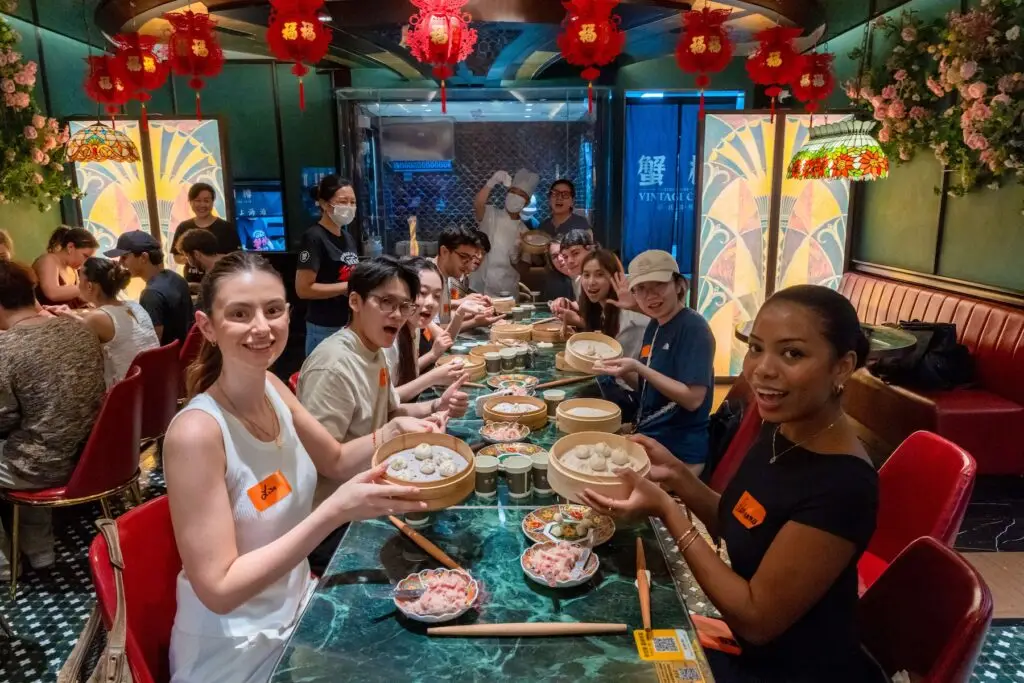
Half-day classes run in Yangshuo, Chengdu, Beijing, and Shanghai: you meet the chef at a wet market to shop for vegetables, tofu, and meat — half the lesson is seeing the ingredients — then cook four or five dishes and eat them for lunch. Each city teaches its own canon: in Shanghai, fold xiaolongbao (小笼包), soup dumplings whose trick is sealing 18 pleats without losing the soup; in Chengdu, Sichuan standards like mapo tofu and Kung Pao prawn; in Beijing, boil dumplings (*jiaozi*) by the dozen. Classes are taught in English and need no prior skill.
Dinner Shows: Where the Performance Is the Point
There is a category of night out where the show matters more than the food — and that is exactly the point. Immersive banquets (沉浸式餐秀) are 2026’s breakout format: staff in hanfu robes and palace maids greet you at the door, and every course arrives with its own scene of historical song and dance.
Xi’an does it most maturely. Its Tang-style palace banquets — the Tang Yue Gong (唐乐宫, Tang Dynasty Palace), running dinner shows since 1988, and newer productions like the Chang’an Palace Banquet (长安宫宴) — wrap a 360° stage around the room, play seven acts from the Qin and Han through the High Tang, serve Tang-style individual courses (the dynasty’s split-meal etiquette), with English subtitles throughout.
Beijing stages imperial court banquets (宫廷宴) around Qianmen, themed on Zhou and Qing palace ritual. Chengdu has the Shu Banquet (蜀宴赋, Shu Yan Fu), a Han–Tang–Song time-travel show on a 360° ice screen, with around 30% of guests foreign visitors. On the Shanghai Bund, TASTE OF CHINA wraps the table in a 270° panoramic projection, matches seven courses to China’s seven culinary regions, and stages Sichuan face-changing opera, water-sleeve dance, and Shaolin kung fu between plates — hanfu hair and makeup optional beforehand.
Tickets are gentler than you’d expect: base seats start around 200 yuan (about $30), hanfu styling plus front-row around 500 yuan (about $70).
One honest caveat: the food is good banquet standard, but you are not really buying a meal — you are buying one evening of time travel. Want it built into your route? We design trips around food — hot pot nights in Chengdu, dim sum in Guangzhou, a Tang banquet in Xi’an. Tell us where you are headed and we will build the food into the itinerary.